BrainGrid
Creates detailed product development plans using AI, consolidating all stages in a single workspace.
Are you the owner?
Claim this tool to publish updates, news and respond to users.
Sign in to claim ownership
Sign InDescription
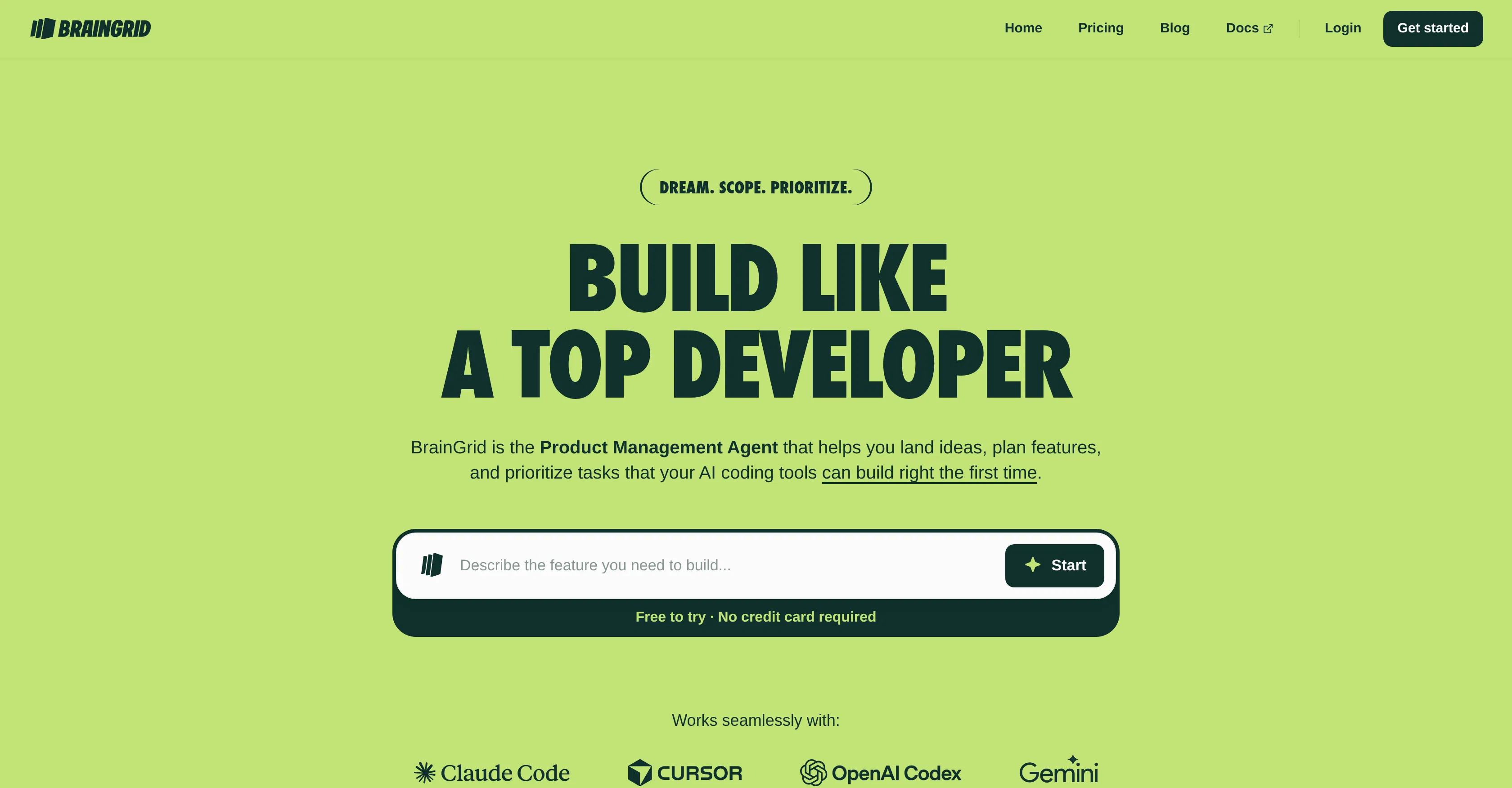
BrainGrid is an AI Product Planner, a product management tool developed by the BrainGrid.ai team. Its core value lies in replacing the chaos of scattered notes, guesses, and endless meetings with a clear, structured action plan. It helps teams move from ideas to concrete, actionable steps, ensuring full transparency into what is being built, why, and in what order, ultimately accelerating product time-to-market.
Key features: the tool offers four key functions unified in a single interface. First, it automatically structures and organizes all ideas, hypotheses, and requirements into a coherent roadmap. Second, it helps decompose large goals into specific, ready-to-implement tasks. Third, it provides a unified view of project status, where the entire team can see progress and priorities. Fourth, it integrates an AI assistant that helps formulate user stories, estimate complexity, and identify potential gaps in the plan.
A distinctive feature of BrainGrid is its focus on 'build readiness'—it doesn't just create wish lists but helps teams focus on what can and should actually be done next. Technically, it's a web application accessible from a browser, with an intuitive drag-and-drop interface. It's designed to integrate into existing workflows, allowing data export or synchronization with other project management tools, though at the time of description, deep integrations, for example with Jira or Linear, may not be available. The emphasis is on simplicity and speed of getting started.
It is ideally suited for product managers, startup founders, and small cross-functional teams looking to systematize their development process. The tool is particularly useful in the early stages, when a raw idea needs to be turned into a structured backlog, or in situations where a team is drowning in disparate information and cannot agree on priorities. It also serves as an excellent communication bridge between product managers, designers, and developers, creating shared context and clarity for all process participants.