Cabina.AI
Unifies access to multiple AI models for content generation, images, and task automation in one interface.
Are you the owner?
Claim this tool to publish updates, news and respond to users.
Sign in to claim ownership
Sign InDescription
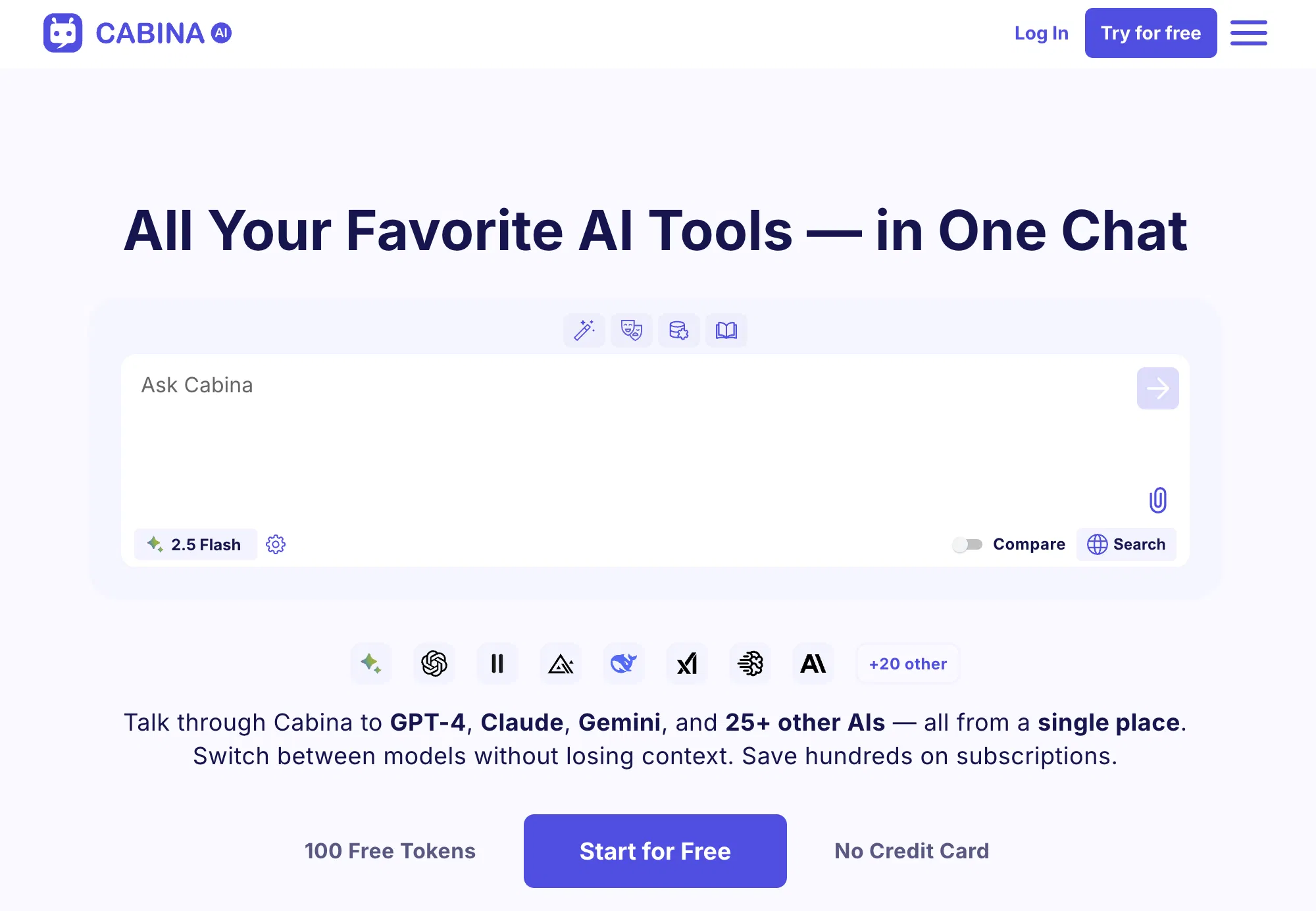
Cabina.AI is a universal web platform that provides access to a wide range of artificial intelligences for solving diverse tasks. Its main value lies in centralizing many powerful models, such as GPT-4, Claude, Gemini, and Stable Diffusion, within a single convenient interface, freeing users from the need to switch between different services. This allows a focus on productivity, whether for creative work, data analysis, or routine automation.
Key capabilities: the platform offers text generation in any format—from posts and articles to code and business correspondence. The second key functionality is creating and editing images via text prompts using advanced models. The third feature is the Keep Context mode, enabling long dialogues with different AIs while preserving the conversation history and context. The fourth is the automation of routine processes through preset workflows. Analysis and processing of uploaded documents and files are also available.
A distinctive feature of Cabina.AI is precisely its multi-model approach, offering the freedom to choose the most suitable AI for a specific task. The platform operates entirely in a browser, requiring no installation, and offers an intuitive design. It integrates both publicly available and specialized models, constantly updating their list. Technically, the service is built around the idea of a unified prompt space, where one can compare responses from different neural networks to a single query, which is especially useful for fine-tuning results.
It is ideally suited for content managers, marketers, entrepreneurs, and freelancers who need a universal tool for daily work with AI. Use cases include quickly preparing commercial texts and creatives for social media, creating illustrations for blogs or presentations, automating responses to standard inquiries, analyzing data from reports, as well as training and experimenting with different language models to find optimal solutions.