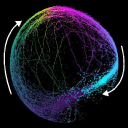
Cebra
Mapping behavioural actions to neural activity is a fundamental goal of neuroscience. As our ability to record large neural and behavioural data increases, there is growing interest in modeling neural dynamics during adaptive behaviors to probe neural representations. In particular, neural latent embeddings can reveal underlying correlates of behavior, yet, we lack non-linear techniques that can explicitly and flexibly leverage joint behavior and
Are you the owner?
Claim this tool to publish updates, news and respond to users.
Sign in to claim ownership
Sign InDescription
Cebra is an advanced machine learning tool designed for neuroscience research, specifically to map behavioral actions to neural activity. Its core value proposition lies in providing a robust, non-linear framework for learning neural latent embeddings that can explicitly and flexibly leverage joint behavior and neural data. This enables researchers to uncover the underlying neural correlates of adaptive behaviors, moving beyond traditional linear models to capture complex, high-dimensional relationships in large-scale recordings.
Key features: Cebra offers a self-supervised learning approach that can handle time series data from both neural recordings (e.g., electrophysiology, calcium imaging) and behavioral measurements (e.g., video tracking, kinematic data). It generates consistent and interpretable latent spaces that reveal how behavior is encoded in neural populations. For example, it can be used to decode an animal's position in a maze from hippocampal activity or to align neural representations across different subjects or sessions. The tool supports various neural data modalities and provides metrics to validate the learned embeddings against ground truth behavior.
What sets Cebra apart is its explicit optimization for joint behavior-neural datasets, unlike many general dimensionality reduction techniques. It is built on a contrastive learning framework that ensures the latent space is invariant to nuisance variables while being predictive of behavior. Technically, it implements a novel algorithm that is scalable to large datasets and offers both Python library and command-line interfaces. It integrates with common neuroscience data formats and analysis pipelines, such as those using NumPy, PyTorch, and data from platforms like SpikeInterface or DeepLabCut, facilitating seamless adoption into existing workflows.
Ideal for computational neuroscientists, research labs, and institutions investigating the neural basis of behavior. Specific use cases include studying spatial navigation, decision-making, motor control, and memory in model organisms like rodents or primates. It is also valuable for brain-machine interface development and for analyzing large-scale neural datasets from modern recording technologies. Industries primarily include academic research, pharmaceutical neuroscience, and neurotechnology companies focusing on decoding neural signals.
The tool operates on a freemium model. The core research code and library are open-source and free to use, supporting individual researchers and small projects. For advanced features, enterprise support, or cloud-based processing of extremely large datasets, paid tiers are available, providing enhanced computational resources, priority support, and customized deployment options.