Cloudgeni
Automatically detects and fixes cloud compliance gaps, configuration drift, and unmanaged resources directly in code.
Are you the owner?
Claim this tool to publish updates, news and respond to users.
Sign in to claim ownership
Sign InDescription
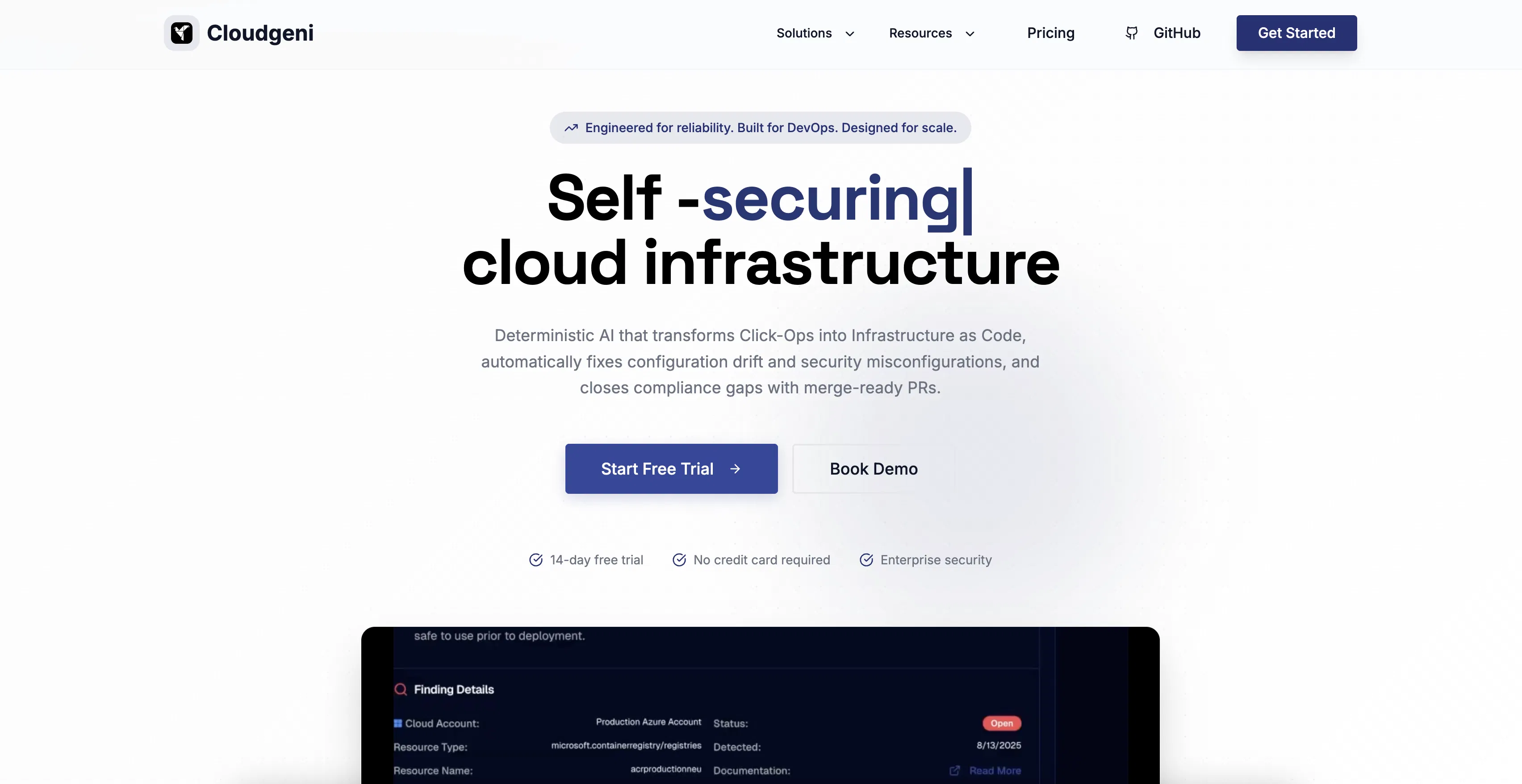
Cloudgeni is a deterministic AI platform designed for cloud infrastructure management, created to empower Infrastructure and DevSecOps teams. Its core value lies in moving beyond mere monitoring to provide automated remediation, ensuring cloud environments are secure, compliant, and efficiently configured by directly addressing issues within the infrastructure-as-code (IaC) layer. This proactive approach significantly reduces manual toil and the window of exposure to potential security risks.
Key features include the automatic detection of compliance violations against standards like CIS, NIST, and GDPR, as well as real-time identification of configuration drift from the intended state. The platform continuously discovers unmanaged or shadow resources that exist outside of IaC definitions. Crucially, it doesn't just alert; it provides automated fixes and pull requests to correct these issues directly in the source code repositories, enabling a true GitOps workflow. It also offers detailed drift analysis and visualization to track changes and their impact over time.
What sets Cloudgeni apart is its deterministic AI engine, which focuses on precise, rule-based analysis and remediation rather than probabilistic alerts, leading to fewer false positives and actionable outcomes. It integrates natively with major cloud providers (AWS, Azure, GCP) and deeply connects with development tools like GitHub, GitLab, and Terraform to embed governance into the existing CI/CD pipeline. The platform operates by scanning both live cloud resources and IaC templates (Terraform, CloudFormation) to maintain a desired state configuration, effectively closing the loop between development and operations.
Ideal for DevOps engineers, SREs, and cloud security specialists who manage complex, multi-cloud environments and are burdened by manual compliance checks and reactive firefighting. Specific use cases include enforcing security policies pre-deployment, maintaining consistency across development, staging, and production environments, and rapidly bringing legacy or ad-hoc cloud deployments under codified management. It is particularly valuable for organizations scaling their cloud footprint who need to maintain governance without sacrificing developer velocity or operational resilience.