ConceptViz
Generates accurate, education-ready science diagrams from complex concepts for teachers and researchers.
Are you the owner?
Claim this tool to publish updates, news and respond to users.
Sign in to claim ownership
Sign InDescription
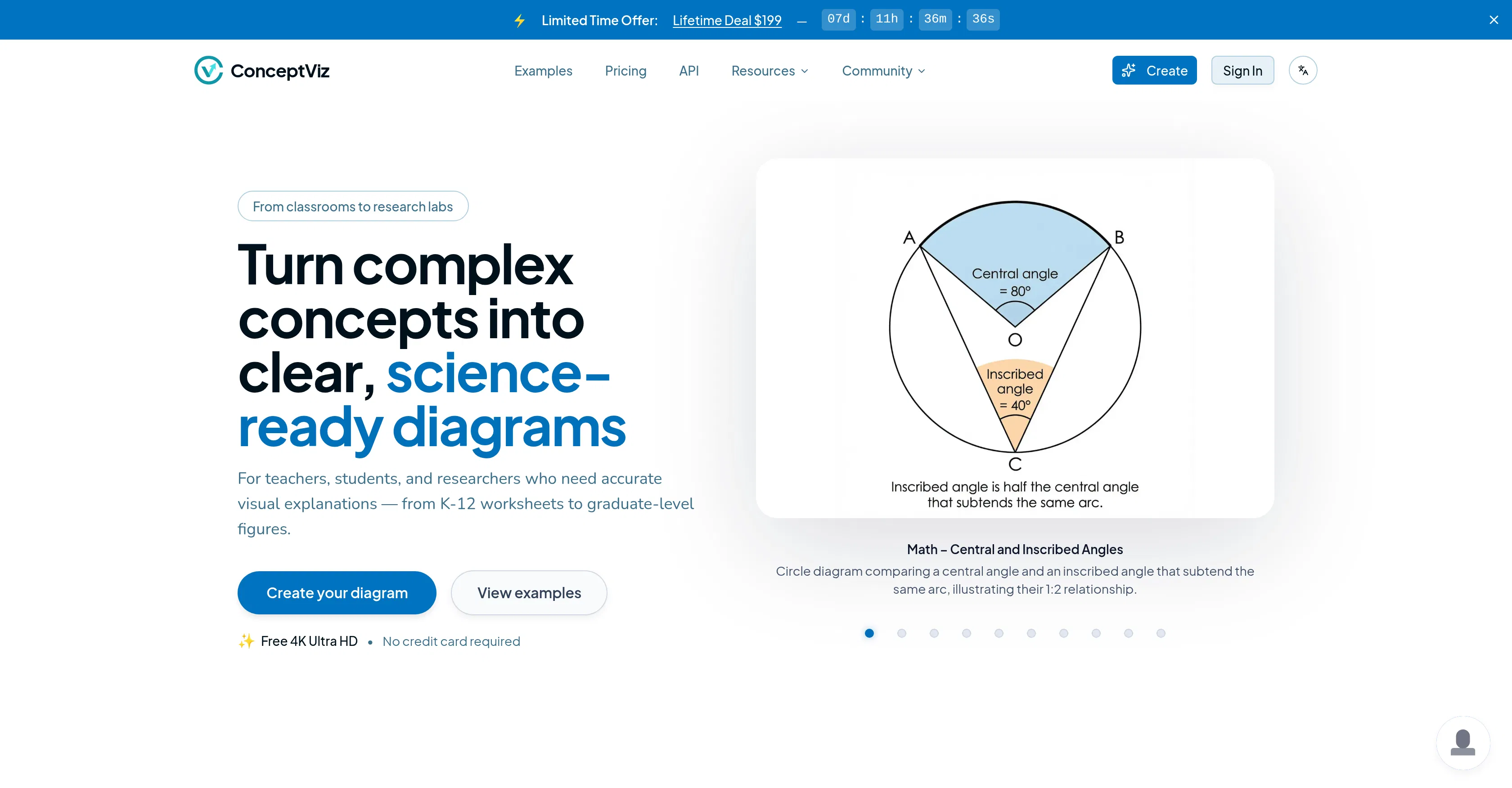
ConceptViz is an AI-powered science diagram generator developed to assist educators and academic professionals in visualizing intricate scientific ideas. Its core value lies in transforming abstract theories and complex data into clear, pedagogically sound visual aids that are immediately suitable for classroom presentations, research papers, and educational materials. By automating the diagram creation process, it saves significant time and ensures visual accuracy, allowing users to focus on teaching and discovery rather than manual illustration.
Key features: The tool can generate diagrams across a comprehensive spectrum of scientific disciplines, including biology, chemistry, physics, and earth sciences. It interprets textual descriptions of concepts to produce labeled, detailed illustrations. Users have control over style and complexity to match different educational levels. The platform supports exporting diagrams in high-resolution formats for print and digital use, and it includes a library of common scientific symbols and templates to accelerate the workflow.
What makes ConceptViz unique is its dedicated focus on scientific accuracy and educational readiness, distinguishing it from general-purpose graphic tools. It employs specialized AI models trained on scientific literature and diagrams to ensure correct terminology and conventional representations. The tool is a web application, accessible from any modern browser without installation, and it emphasizes a user-friendly interface that requires no prior design expertise. While it operates as a standalone service, its output seamlessly integrates into presentation software, document editors, and learning management systems.
Ideal for science teachers at secondary and university levels needing to create custom visual explanations for lessons, as well as researchers and students preparing manuscripts, theses, or conference posters. Specific use cases include generating detailed cell structures for a biology class, illustrating chemical reaction mechanisms, mapping geological processes, or creating physics concept maps to explain fundamental principles in an engaging, visual manner.