Elicit
Searches and analyzes scientific articles for researchers, saving time on literature review.
Are you the owner?
Claim this tool to publish updates, news and respond to users.
Sign in to claim ownership
Sign InDescription
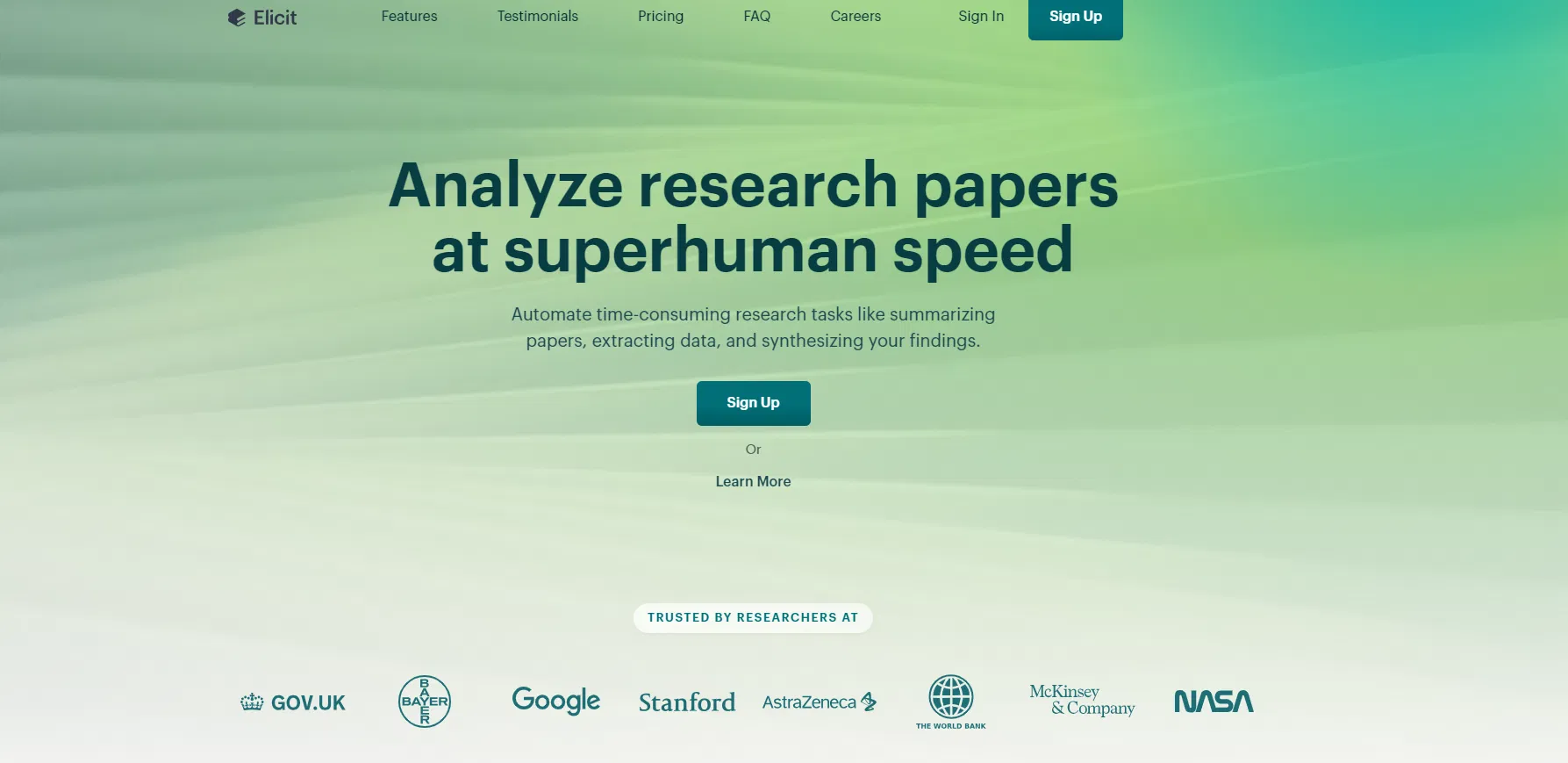
Elicit is a specialized AI assistant for researchers, developed by the company Ought of the same name. Its primary value lies in radically accelerating and deepening work with scientific literature, positioning itself as 'artificial intelligence for scientific discovery.' The service is built on advanced language models, including GPT and proprietary developments optimized for understanding academic context and semantic search.
Key capabilities include automated search and semantic analysis of relevant scientific articles based on natural language queries, such as 'how do social networks affect anxiety in teenagers.' The tool does not just provide a list of links but extracts key findings, methods, and results directly from abstracts and full PDF texts. It can compare findings from multiple studies, summarize them in tabular form, and answer specific research questions, testing hypotheses. A separate feature allows for conducting systematic literature reviews by automatically classifying articles according to given criteria.
Elicit's uniqueness lies in its deep specialization in scientific discourse, distinguishing it from universal chatbots like ChatGPT. Its engine is trained to understand the specifics of academic publications, correctly handle citations, and assess research quality. The service offers both a free plan with a limited number of queries and professional subscriptions with increased limits, access to full texts, and priority processing. A technical advantage is direct integration with semantic databases of scientific articles, such as Semantic Scholar, ensuring work with an up-to-date corpus of knowledge.
It is ideally suited for scientists, graduate students, analysts in R&D departments, and students working on thesis or dissertation writing. Specific scenarios include preparing a literature review for a new paper, quickly verifying existing hypotheses on a topic, identifying research gaps, and tracking current trends in one's scientific field without the routine of reviewing hundreds of abstracts.