Flowstep
Generates and edits production-ready UI designs from prompts and references in minutes.
Are you the owner?
Claim this tool to publish updates, news and respond to users.
Sign in to claim ownership
Sign InDescription
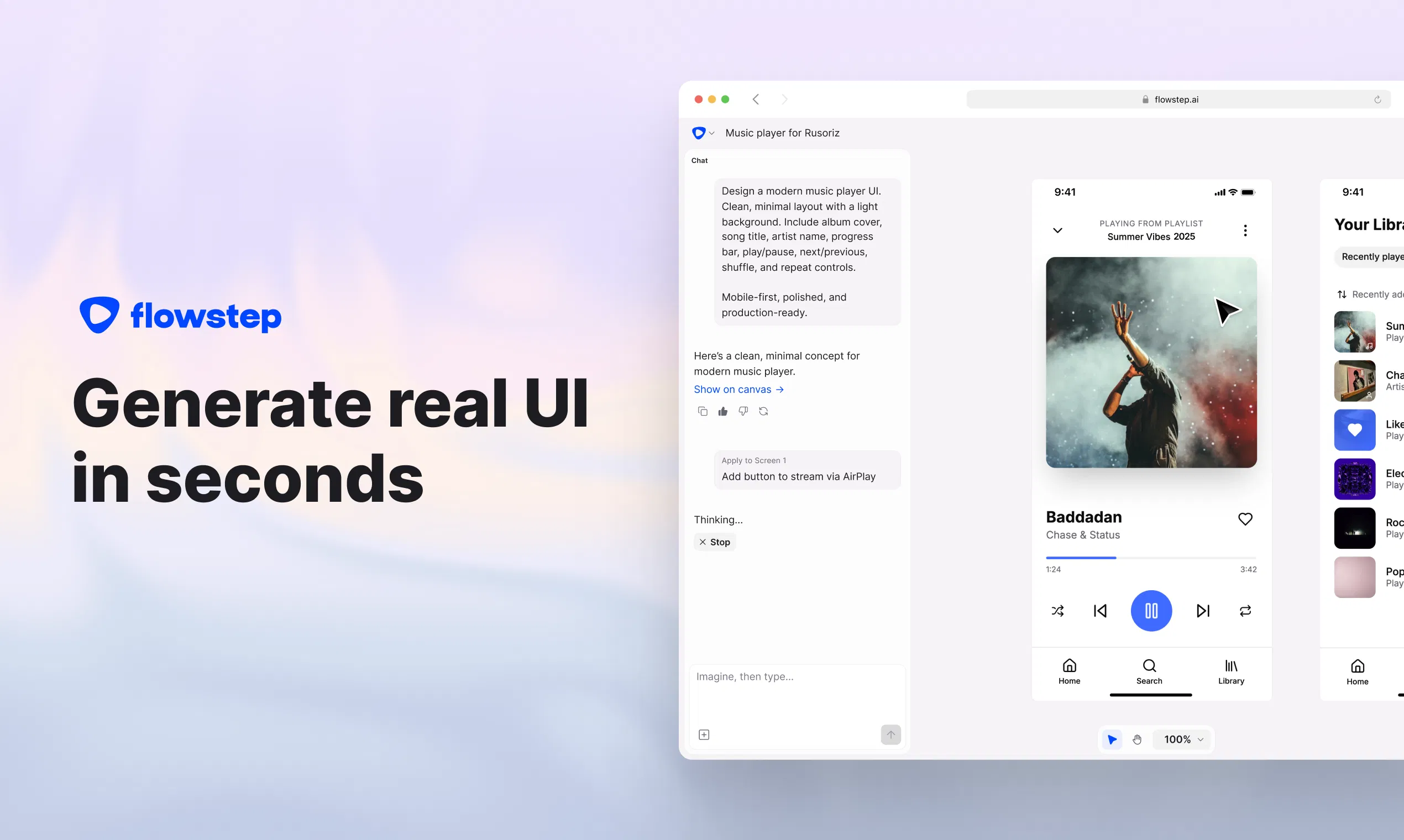
Flowstep is an AI-powered design assistant created to help product teams accelerate their workflow from initial concept to fully realized, production-ready user interfaces. Its core value lies in dramatically reducing the time and effort required in the traditional design process, enabling designers and product managers to iterate rapidly and visualize ideas almost instantaneously. By acting as a collaborative partner, it bridges the gap between abstract requirements and tangible visual prototypes, making high-fidelity design accessible at the speed of conversation.
Key features include the ability to generate single screens or up to ten interconnected screens from a single text prompt, allowing for the swift creation of entire user flows. Users can design using various references such as Product Requirement Documents (PRDs), existing images, or wireframes to guide the AI. The platform supports real-time editing through a chat interface, where designers can instruct the AI to modify layouts, adjust components, or change styles conversationally. Additionally, it facilitates team collaboration by providing tools to share, review, and refine AI-generated designs within a unified workspace.
What sets Flowstep apart is its deep integration of conversational AI directly into the design editing environment, treating design adjustments as a dialogue rather than a manual task. Technically, it leverages advanced generative models specifically fine-tuned for UI/UX patterns, ensuring outputs are not just visually coherent but also adhere to usability principles. It operates as a web-based platform, ensuring accessibility without complex installations, and is built to integrate with popular design and project management tools, though specific integration details are often updated. Its focus on producing 'production-ready' assets means the generated designs consider practical implementation constraints, saving downstream engineering time.
Ideal for product designers, UX/UI teams, startup founders, and product managers who need to quickly prototype ideas, validate concepts with stakeholders, or overcome creative blocks. Specific use cases include rapidly mocking up new features based on PRDs, creating multiple design variations for A/B testing, generating complete design systems from a brand brief, and refining existing interfaces through natural language commands, all of which streamline the path from idea to market-ready digital product.