
FormHug
Creates interactive forms for humans and AI agents, simplifying data collection for teams and organizers.
Are you the owner?
Claim this tool to publish updates, news and respond to users.
Sign in to claim ownership
Sign InDescription
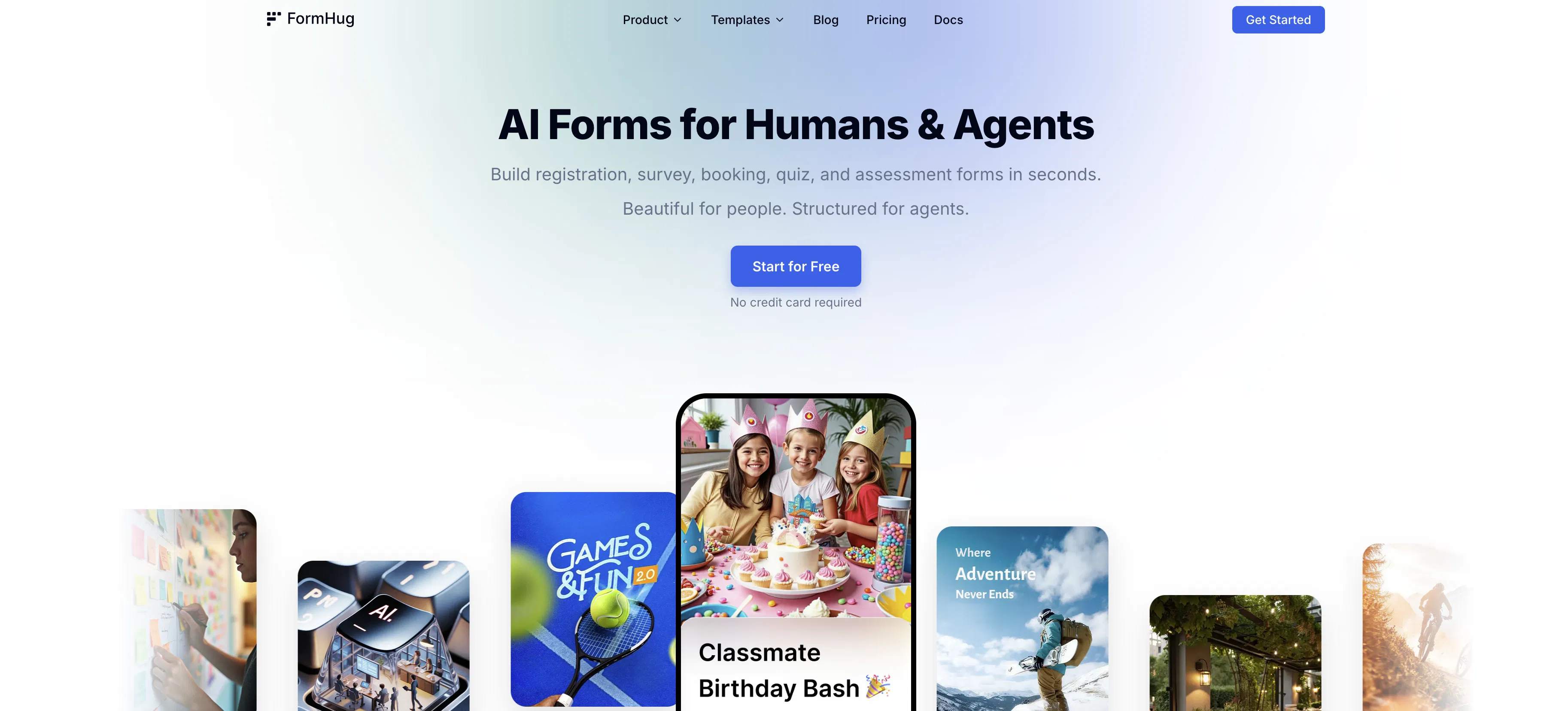
FormHug is a modern service for building intelligent forms, designed for effective interaction with both humans and AI agents. The tool positions itself as a next-generation solution that goes beyond static surveys, turning data collection into a dynamic and context-dependent dialogue. Its core is likely built on a combination of language models and conditional logic, allowing forms to adapt to respondent answers in real time.
Key features include creating complex multi-step forms with scenario branching, where subsequent questions depend on previous answers, ideal for lead qualification, in-depth surveys, or event registration. Integration with AI agents enables automatic processing and structuring of incoming data, such as resumes or feedback, saving time on routine analysis. The service supports embedding forms on websites and in messengers, offers templates for various tasks, and ensures data collection in a structured format with export capabilities.
The uniqueness of FormHug lies in its bidirectional nature: it is created not only for humans but also as an interface for software agents, opening possibilities for automating business processes, such as processing applications via chatbots. Unlike traditional builders like Typeform or Google Forms, the emphasis here is on flexible logic and machine-readable data output. A technical advantage is the API for integration with external systems and platforms, allowing interactive forms to be embedded into existing CRM or support system workflows.
It is ideally suited for product managers, event organizers, and marketing and HR teams who need not just collection, but intelligent processing of information. Specific scenarios include conducting adaptive user experience research, automated job application intake with preliminary sorting, creating interactive guides for clients, or collecting structured feedback that an AI assistant can immediately use to generate reports.