
HappySRT
Transcribes audio/video to text with timestamps, translates, and summarizes content in minutes.
Are you the owner?
Claim this tool to publish updates, news and respond to users.
Sign in to claim ownership
Sign InDescription
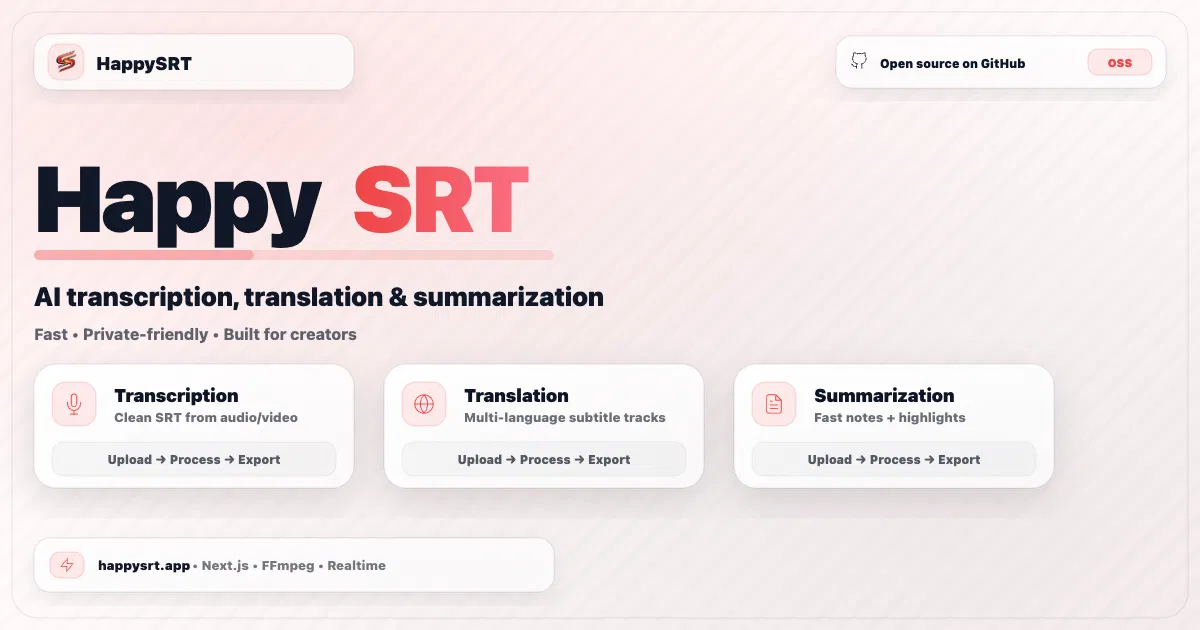
HappySRT is an AI-powered workspace designed for efficient media content processing, created to streamline workflows for professionals and creators. Its core value lies in transforming spoken content from audio or video files into structured, actionable text data quickly and accurately, eliminating the need for manual transcription. The platform accepts direct uploads or media URLs, making it highly accessible for users who need to work with interviews, lectures, podcasts, or meeting recordings. By automating the initial heavy lifting of content extraction, it allows users to focus on analysis, editing, and distribution.
Key features include high-accuracy speech-to-text transcription that automatically generates timestamps ready for SRT subtitle file export. It offers translation capabilities across multiple languages, enabling content localization. The tool provides summarization to distill long recordings into key points, and it supports various export formats for text and subtitles to integrate into video editors or documentation. Users can also edit transcripts directly within the interface for corrections and refinements.
What sets HappySRT apart is its integrated all-in-one approach, combining transcription, translation, and summarization in a single streamlined interface, which is optimized for speed and export readiness. Technically, it leverages advanced automatic speech recognition (ASR) models to handle different accents and audio qualities. It operates as a web application, requiring no software installation, and focuses on a clean, user-friendly design. While it may integrate with workflows through exported files, its primary strength is as a standalone, purpose-built tool for media processing tasks.
Ideal for video editors, content creators, journalists, researchers, and educators who regularly need to convert audio or video recordings into text-based assets. Specific use cases include creating subtitles for YouTube videos, transcribing interviews for articles, summarizing lecture notes for students, translating podcast episodes for international audiences, and documenting business meetings for archives or action items. It is particularly valuable for freelancers and teams looking to save time on manual transcription and accelerate content repurposing across different formats and languages.
Similar Tools