
HeyScience
Summarizes scientific articles and academic papers using AI to extract key insights.
Are you the owner?
Claim this tool to publish updates, news and respond to users.
Sign in to claim ownership
Sign InDescription
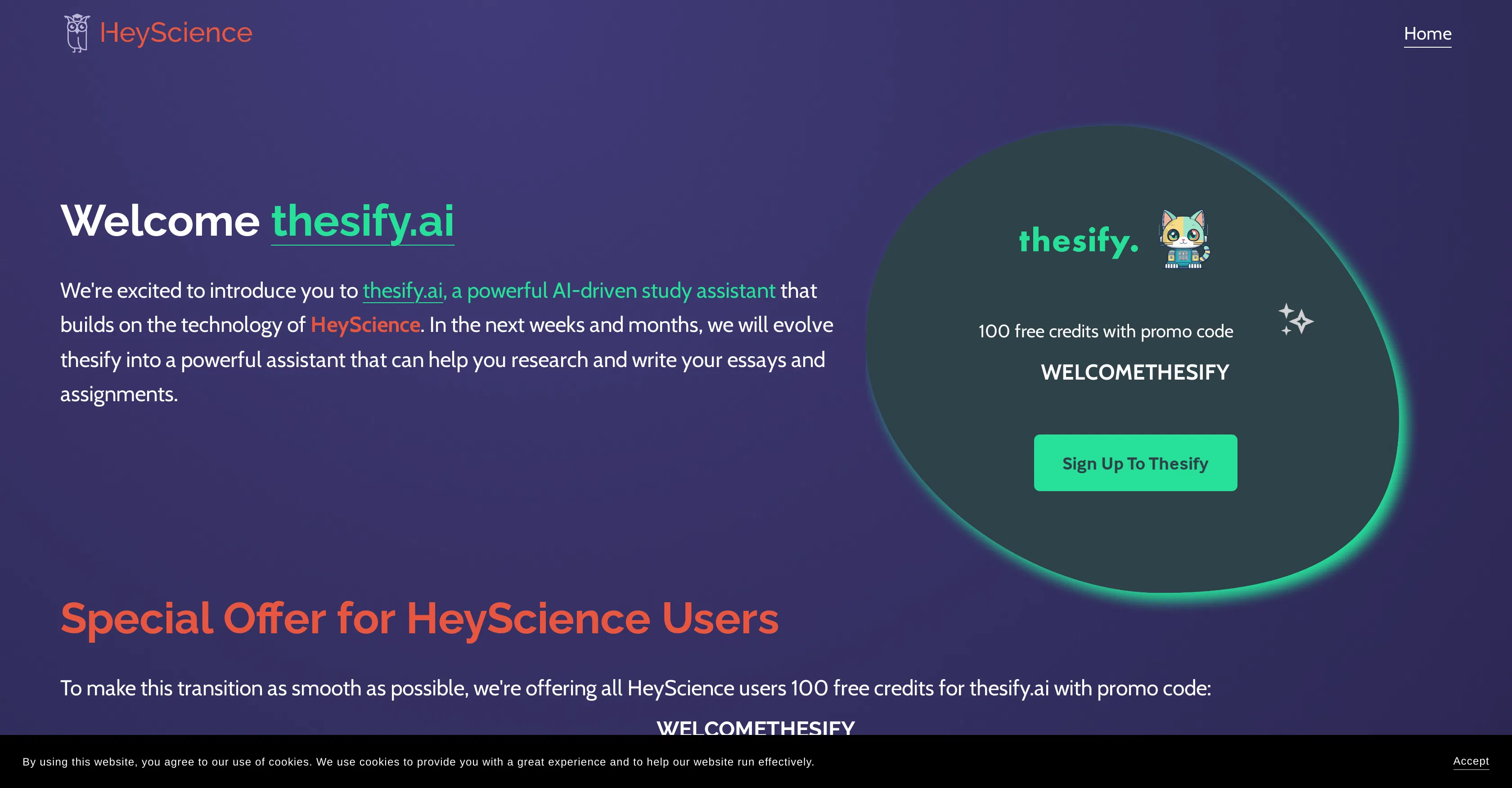
HeyScience is an AI-powered personal assistant originally developed to support academic work, which has since evolved into a broader platform. Created to aid researchers and students, its core value lies in dramatically reducing the time required to digest complex scientific literature by providing concise, accurate summaries. The technology behind it has been further utilized and extended in a separate platform called Thesify.ai, indicating a foundation built for rigorous information processing. This tool addresses the common challenge of information overload in academia by acting as an intelligent filter for essential knowledge.
Key features: The tool can process and summarize lengthy scientific articles, extracting the main hypotheses, methodologies, results, and conclusions. It helps users quickly identify relevant papers from a large corpus based on their research interests. The AI can explain complex scientific terms and concepts in simpler language, aiding comprehension. It also assists in organizing and managing a personal library of reviewed literature, keeping track of key references and notes for future use.
What makes it unique is its specific training and optimization for academic and scientific texts, unlike general-purpose summarization tools. It understands the structure and formal language of research papers, allowing for more context-aware analysis. The platform is primarily web-based, ensuring accessibility from any device with a browser. While initially a standalone service, its underlying technology has been integrated into Thesify.ai, suggesting a robust and transferable AI engine capable of powering multiple educational and research-oriented applications.
Ideal for university students, graduate researchers, and academics across all scientific disciplines who need to conduct literature reviews efficiently. It is also valuable for professionals in R&D departments who must stay current with the latest publications in their field. Specific use cases include preparing for a new research project, studying for comprehensive exams, writing a thesis literature review, or quickly gauging the relevance of newly published papers to one's ongoing work without reading each document in full.