
Ideamap - Brainstorm and Mindmap AI
Facilitates collaborative brainstorming and mind mapping with AI-powered idea generation and structuring.
Are you the owner?
Claim this tool to publish updates, news and respond to users.
Sign in to claim ownership
Sign InDescription
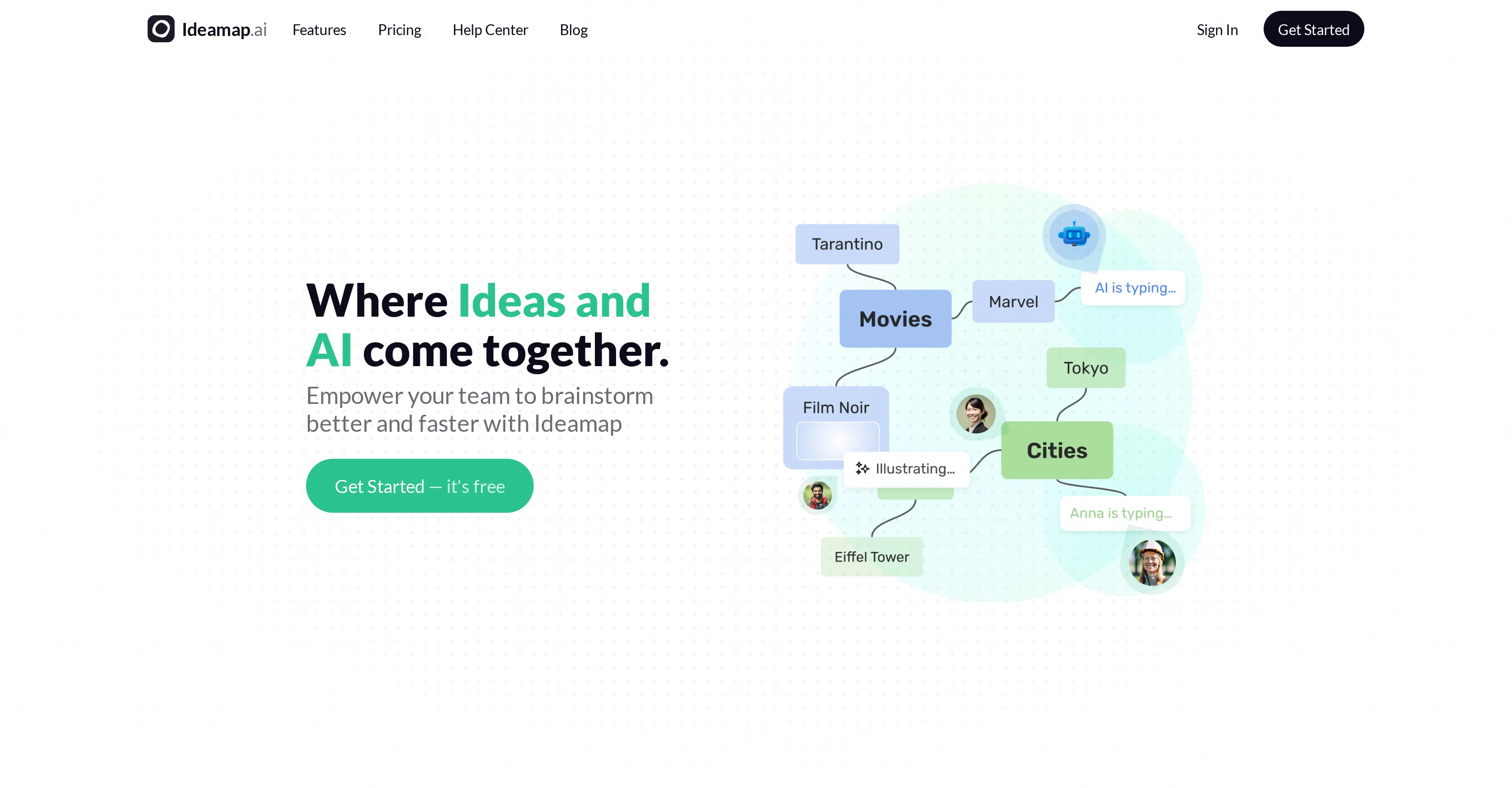
Ideamap is an interactive service for collective brainstorming and mind mapping, created by a development team focused on collaboration tools. Its main value lies in transforming the traditional idea generation process into a dynamic dialogue with artificial intelligence, which acts as an active participant and session moderator. The service likely uses advanced language models such as GPT-4 to understand context, expand, and structure users' thoughts in real time.
Key features: the platform allows teams to create, edit, and branch ideas on an infinite interactive board in real time, where each idea node can be developed or supplemented with AI. Users can request AI to generate new associations, opposing viewpoints, grouping and categorization of chaotic thoughts, as well as formulation of clear theses from raw notes. A technical feature is two-way interaction: AI not only responds to requests but also suggests directions for deepening by asking clarifying questions and revealing hidden connections between concepts.
Ideamap's uniqueness lies in the deep integration of AI specifically into the collaborative process, not just individual content generation. Unlike static mind mapping tools, here AI acts as a facilitator, helping to overcome creative blocks and systematize the team's flow of ideas. The service offers various subscription plans, including a free tier with a limited number of maps and team plans with extended version history and access rights. It works directly in the browser without requiring installation and ensures smooth synchronization of changes between all session participants.
Ideal for product managers, designers, marketers, research teams, and startups conducting strategic sessions, planning projects, or developing new concepts. Specific scenarios include collaborative development of hypotheses for a new product, structuring technical specifications, planning content strategy, or academic research where it's necessary to visualize complex interconnections of ideas and ensure each participant's contribution.