
LabelGPT
Automates image annotation by generating labels on raw images using generative AI.
Are you the owner?
Claim this tool to publish updates, news and respond to users.
Sign in to claim ownership
Sign InDescription
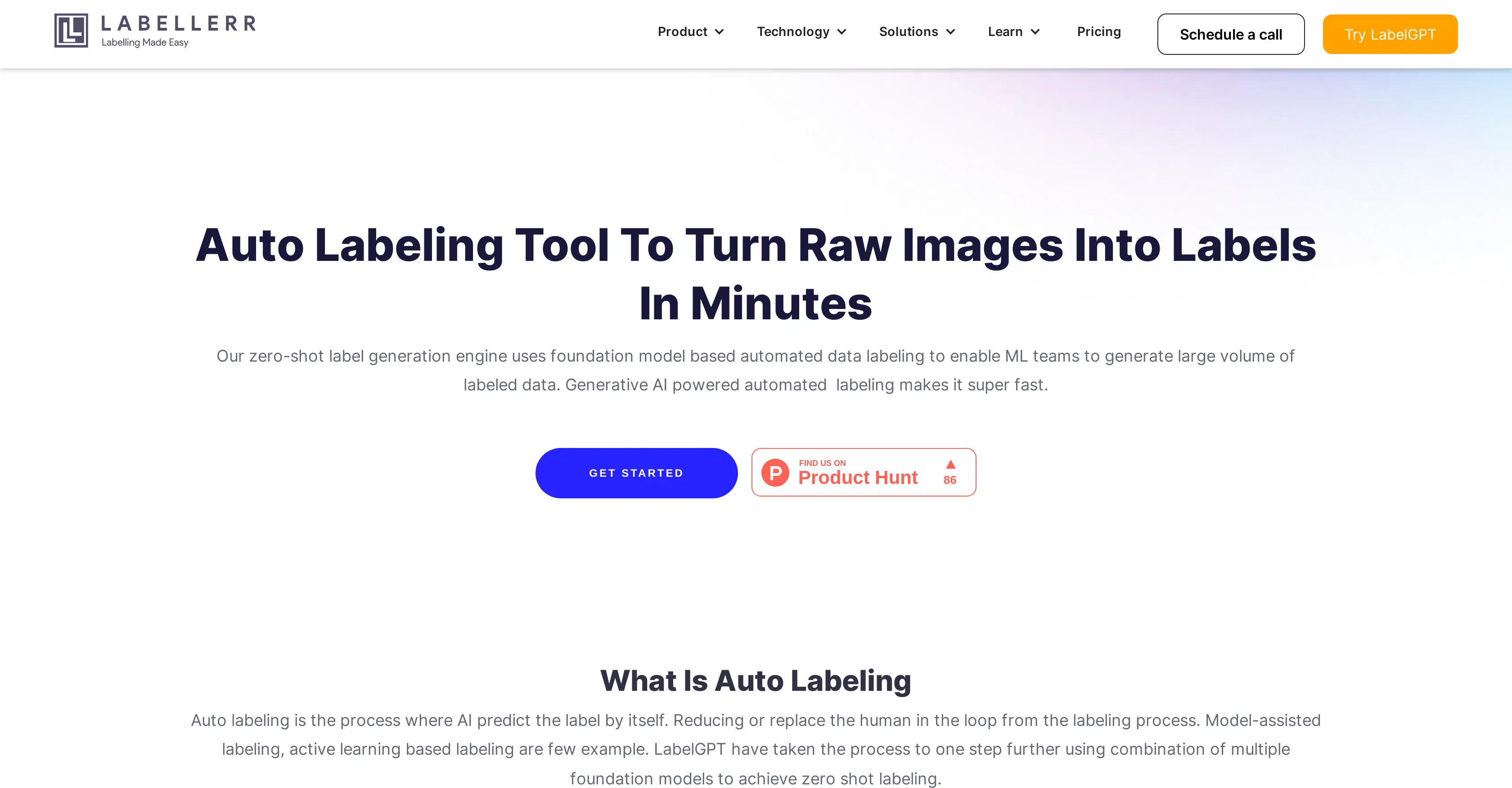
LabelGPT is an automated image annotation tool developed by Labellerr, powered by a generative AI model. Its primary value lies in accelerating the data preparation pipeline for machine learning by automatically generating initial labels on raw, unlabeled images, significantly reducing the manual effort required from data scientists and annotation teams. This tool directly addresses the bottleneck of creating high-quality training datasets, enabling faster iteration and deployment of computer vision models.
Key features include the ability to import data from various local and cloud sources such as AWS, GCP, and Azure. The core generative AI model can produce bounding boxes, polygons, and segmentation masks across diverse object categories. Users can then review, correct, and refine these AI-generated annotations within an intuitive interface, ensuring dataset accuracy. The platform supports collaborative workflows, allowing teams to manage annotation projects, assign tasks, and maintain version control over datasets efficiently.
What sets LabelGPT apart is its foundation on a specialized generative model fine-tuned for annotation tasks, rather than a generic vision model, which improves precision for domain-specific data. It operates as a web-based platform, requiring no complex local setup, and integrates seamlessly with popular cloud storage providers and data pipelines. The technical approach focuses on reducing initial annotation time by up to 80%, providing a smart starting point that human annotators can perfect, thereby blending AI efficiency with human oversight for optimal results.
Ideal for data science teams, AI researchers, and companies developing computer vision applications who need to scale their data labeling operations. Specific use cases include preparing datasets for autonomous vehicle perception systems, medical image analysis, retail inventory management via image recognition, and quality inspection in manufacturing. It is particularly valuable for projects with large volumes of image data where manual annotation would be prohibitively time-consuming and costly.