
Locutio
Automates translation of application interfaces into multiple languages with context awareness.
Are you the owner?
Claim this tool to publish updates, news and respond to users.
Sign in to claim ownership
Sign InDescription
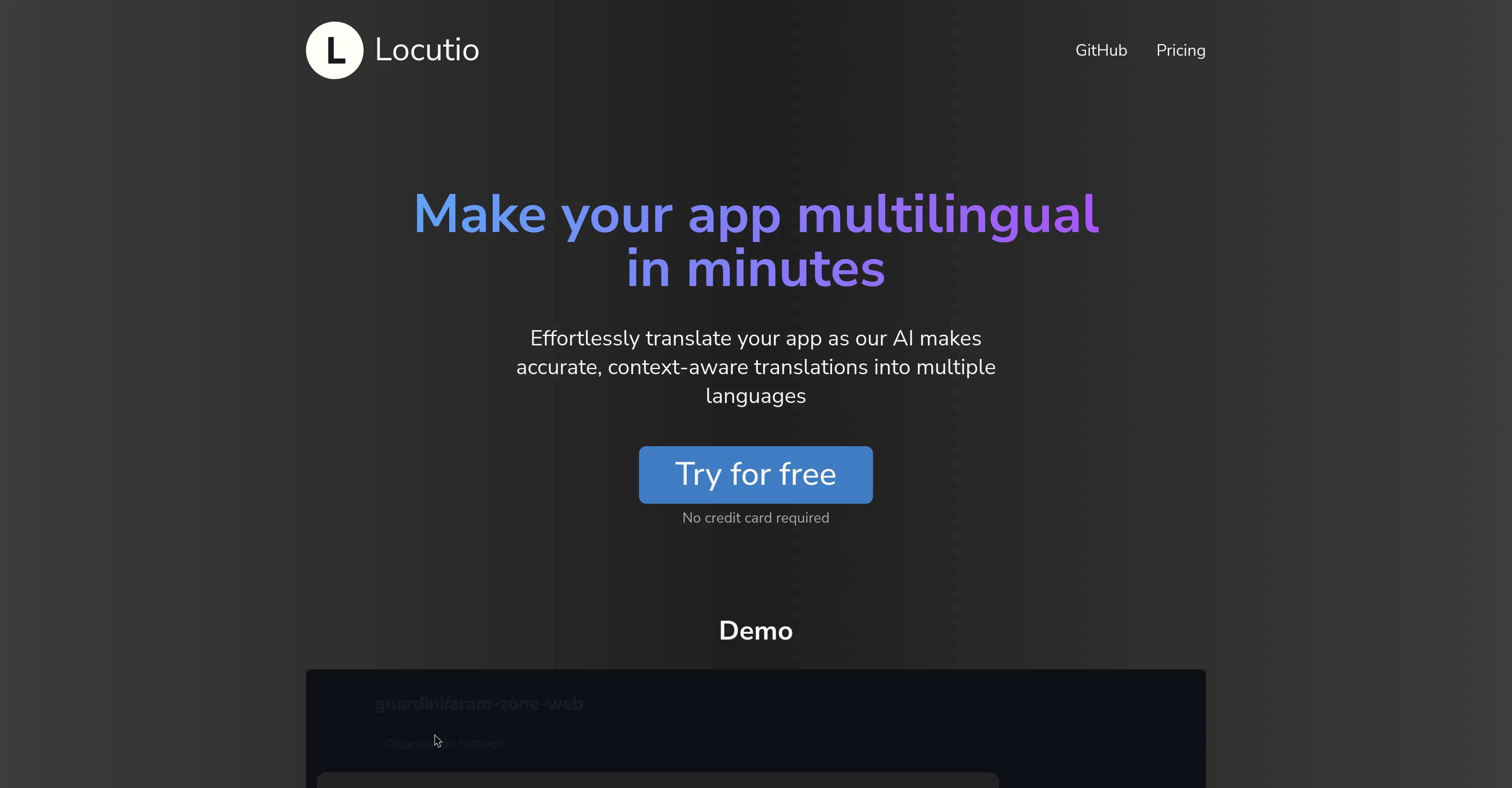
Locutio is a specialized AI tool for application localization, designed for developers. Its primary value lies in enabling the translation of software products into multiple languages while minimizing manual effort and ensuring high accuracy through contextual understanding. This transforms the complex and labor-intensive localization process into a faster and more manageable one, helping developers launch their applications on the international market.
Key features: The tool offers automatic translation of user interface (UI) text strings with consideration for the software context, reducing errors. It supports working with popular file formats used in development, such as JSON, YAML, and PO files. The system provides a centralized dashboard for tracking translation progress and managing language versions. A collaboration feature is also available, allowing professional translators to be brought in to review and edit machine translations, ensuring the highest quality.
A distinctive feature of Locutio is its deep integration into the developer's workflow. It can connect to code repositories (e.g., on GitHub or GitLab) to automatically extract new strings for translation and subsequently return completed localizations. This creates a continuous localization cycle. Technically, the tool uses advanced machine translation models that are fine-tuned on IT-specific terminology, which is critical for accuracy. It operates as a web platform, requiring no complex installation.
It is ideally suited for individual developers and teams creating mobile and web applications planning a global launch. The tool is indispensable for startups aiming to quickly adapt their product for different regions with limited resources. It will also be useful for companies maintaining a large number of language versions, where manual translation management becomes inefficient. Use cases include initial localization of a new application, regular translation updates for new releases, and long-term localization quality maintenance.