Migaku
Turns any website into an interactive language learning environment with instant translations and vocabulary tracking.
Are you the owner?
Claim this tool to publish updates, news and respond to users.
Sign in to claim ownership
Sign InDescription
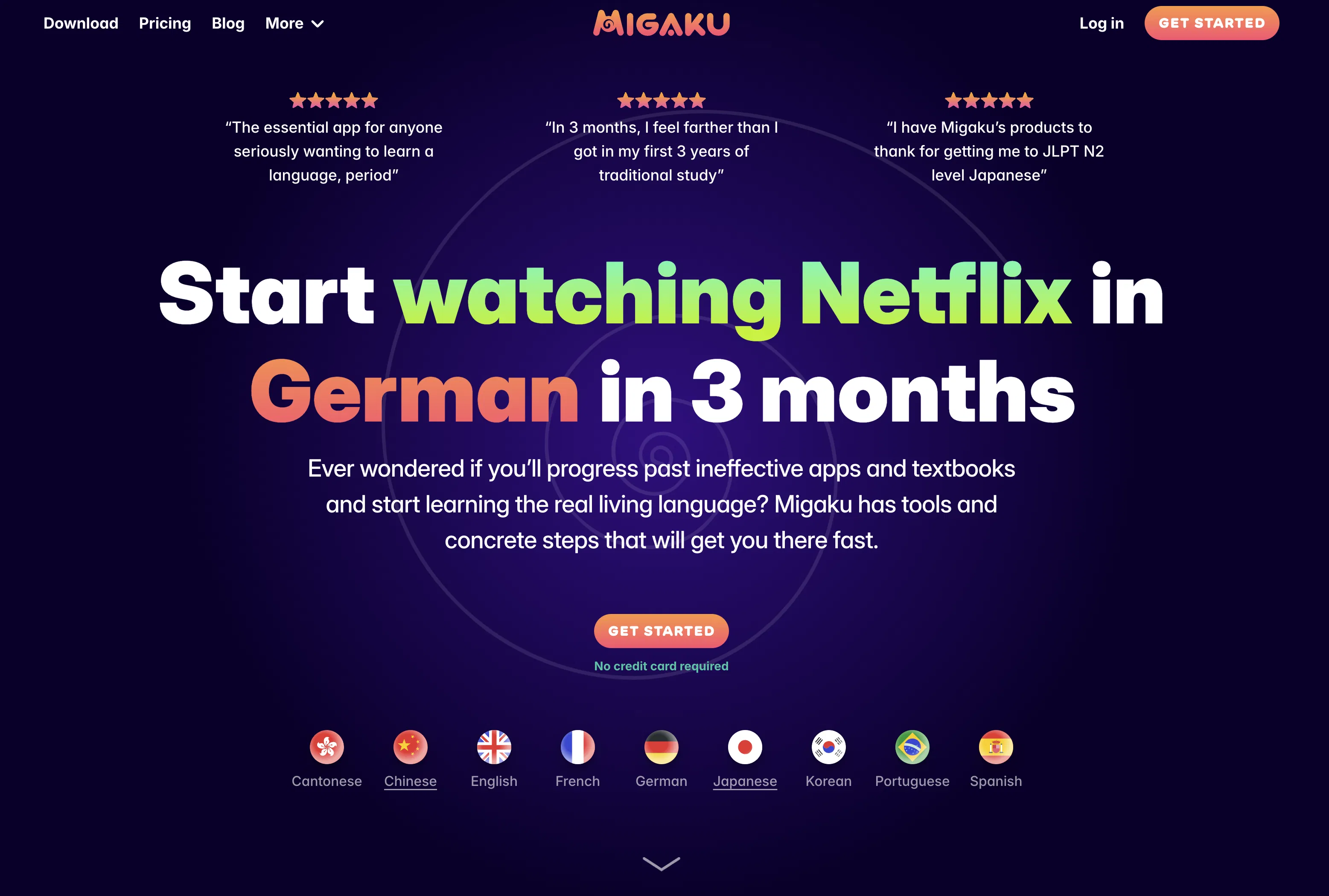
Migaku is a comprehensive Chrome browser extension designed to facilitate immersive language acquisition by transforming everyday web browsing into a structured learning session. Developed by a team focused on leveraging authentic content, its core value lies in enabling learners to study directly from the native material they already enjoy, such as news articles, social media, or streaming platforms, thereby making practice both relevant and engaging. It supports a wide array of languages including Spanish, Chinese, English, German, Korean, and Japanese, catering to a global user base seeking a more natural learning curve.
Key features include the ability to instantly look up and save words with a single click, creating personalized flashcards integrated with spaced repetition systems (SRS) for optimal retention. The tool automatically generates audio for saved vocabulary using high-quality text-to-speech and can parse subtitles from video platforms like YouTube and Netflix to extract sentences and vocabulary. It also includes a built-in dictionary, a pop-up dictionary for quick lookups, and a reading assistant that can annotate entire web pages with furigana or phonetic guides for languages like Japanese, significantly lowering the barrier to reading complex texts.
What sets Migaku apart is its deep integration with the browser and popular media sites, allowing for a seamless, non-disruptive learning flow where study happens in the context of actual usage rather than in a separate app. Technically, it operates as a sophisticated overlay that interacts with webpage text and video player APIs, supporting custom card formats and advanced SRS algorithms. It is primarily a browser-based tool for Chrome, with companion mobile apps planned to sync learning progress, and it integrates with Anki, allowing users to export their flashcards for use in that popular memory system, providing great flexibility for serious learners.
Ideal for intermediate to advanced language learners who want to move beyond textbook exercises and immerse themselves in authentic content, as well as for self-directed beginners who need extensive support. Specific use cases include a learner watching a Japanese drama on Netflix and effortlessly mining vocabulary from the subtitles, a student reading a German news article and building a flashcard deck from encountered terms, or a professional preparing for work in a Mandarin-speaking environment by studying industry-specific websites with full phonetic and dictionary support.