
Monterey
Gathers and analyzes customer feedback from multiple sources to identify satisfaction and pain points.
Are you the owner?
Claim this tool to publish updates, news and respond to users.
Sign in to claim ownership
Sign InDescription
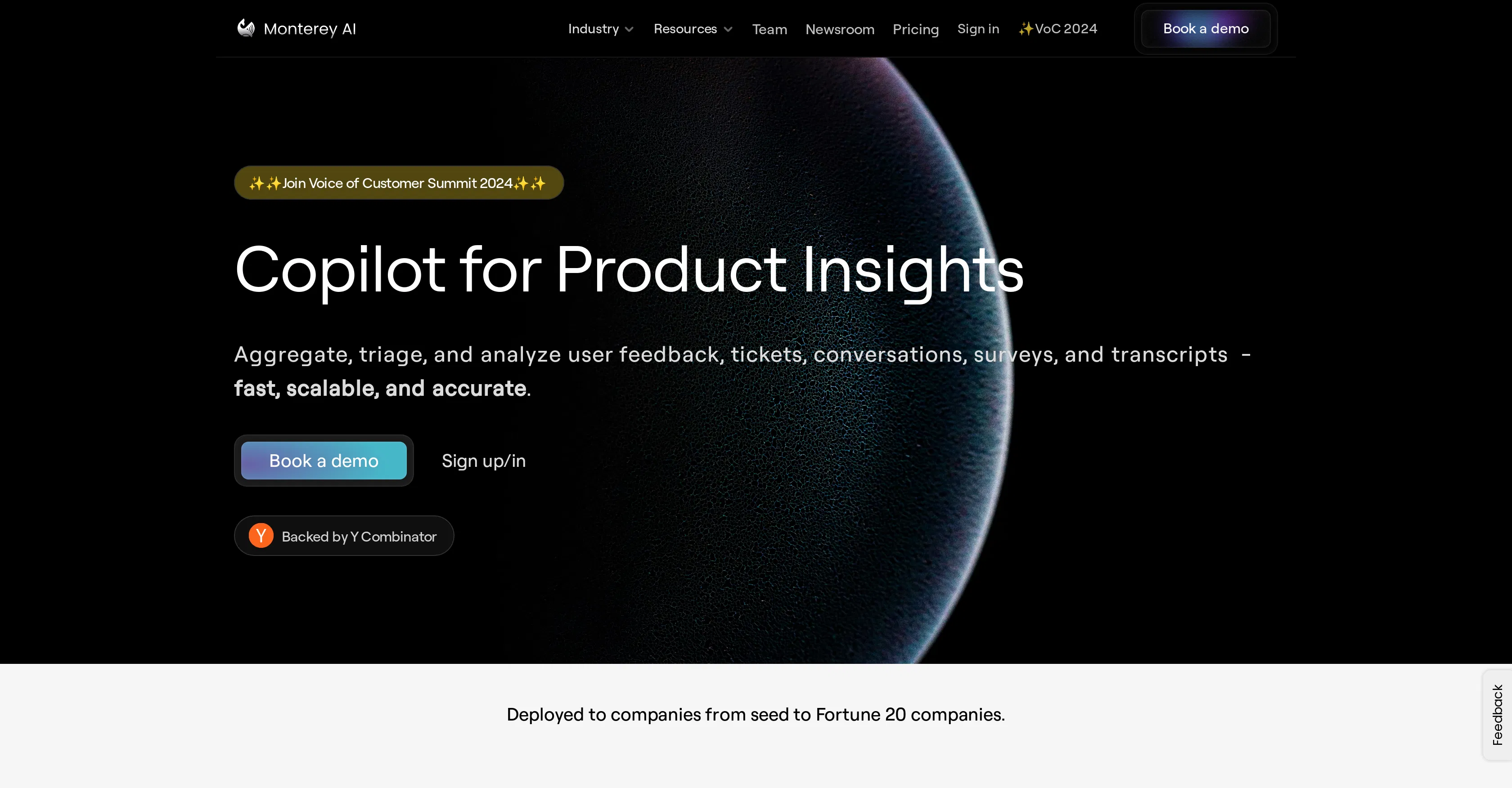
Monterey AI is a specialized platform designed to streamline the voice of the customer (VoC) process, created to help product and customer experience teams make data-driven decisions. It centralizes feedback scattered across various digital touchpoints, providing a unified view of customer sentiment. The primary value lies in transforming raw, unstructured feedback into actionable insights, enabling teams to prioritize improvements that directly impact customer satisfaction and retention, thereby bridging the gap between user input and strategic product development.
Key features include the automated aggregation of feedback from sources like app stores, support tickets, social media, and survey platforms into a single dashboard. The tool employs AI to categorize and tag this feedback automatically, surfacing common themes, feature requests, and urgent complaints. It performs sentiment analysis to gauge emotional tone and tracks how specific issues or praises evolve over time. Advanced capabilities also include generating summaries from large volumes of text and setting up custom alerts for spikes in negative feedback or mentions of critical keywords, ensuring teams can respond proactively.
What sets Monterey AI apart is its focus on product-led growth and its ability to connect qualitative feedback with quantitative metrics, often integrating with analytics tools to show how sentiment correlates with user behavior. Technically, it leverages natural language processing (NLP) models trained specifically on customer feedback data for higher accuracy in theme detection. The platform is cloud-based and accessible via web browser, offering integrations with popular tools like Slack, Jira, Intercom, Zendesk, and Google Play/App Store Connect, creating a seamless workflow for cross-functional teams without requiring extensive manual data entry.
Ideal for product managers, customer success teams, and UX researchers in companies that rely heavily on user feedback for iteration. Specific use cases include prioritizing a product roadmap based on the volume and sentiment of feature requests, quickly identifying and addressing a bug or usability issue reported across multiple channels, and preparing detailed customer insight reports for stakeholder meetings without manual data compilation. It is particularly valuable for SaaS companies, mobile app developers, and e-commerce platforms seeking to reduce churn and enhance user loyalty through a systematic understanding of customer voices.