
MyLens.AI
Explores historical timelines and uncovers intersections between different historical narratives.
Are you the owner?
Claim this tool to publish updates, news and respond to users.
Sign in to claim ownership
Sign InDescription
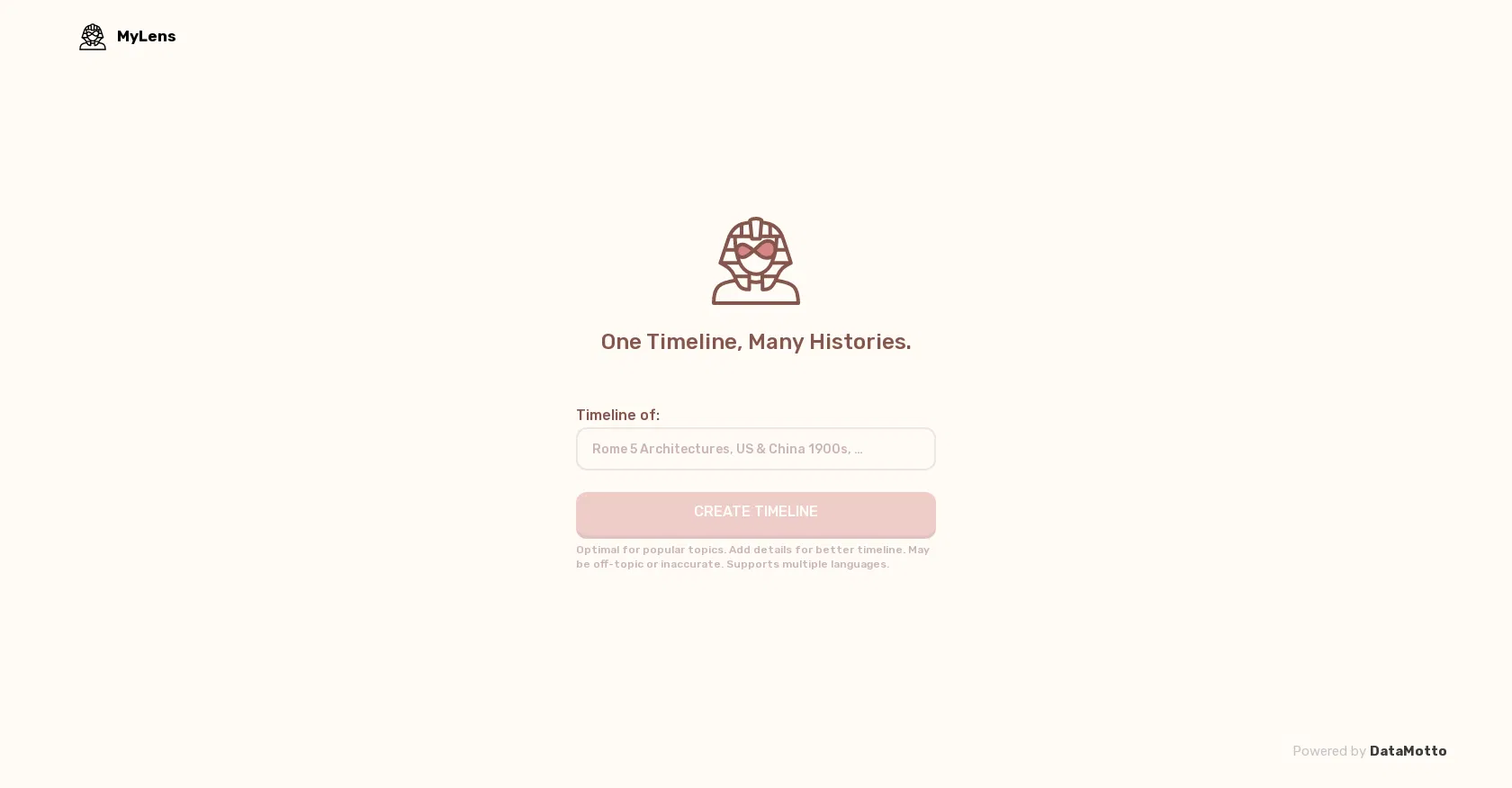
MyLens.AI is an AI-powered platform designed to map and visualize historical events, created to help users discover the complex connections between different stories across time. Its core value lies in transforming scattered historical data into interactive, interconnected timelines, providing a structured and insightful way to understand the past beyond simple linear narratives. By leveraging artificial intelligence, the tool synthesizes information to reveal patterns and influences that might otherwise remain hidden in traditional historical study.
Key features include the ability to create detailed, multi-threaded timelines from user queries or imported data, and an AI that automatically suggests relevant connections and parallel events between different historical narratives. Users can explore pre-built timelines on various topics, contribute to collaborative timeline projects, and visualize events with rich media attachments. The platform also supports filtering and searching across timelines to pinpoint specific periods, figures, or themes, making historical research more dynamic and accessible.
What sets MyLens.AI apart is its focus on narrative intersection and contextual linking, rather than just listing dates. Technically, it uses natural language processing to understand historical queries and machine learning to propose meaningful chronological relationships. It operates as a web application, ensuring broad accessibility without the need for specialized software. While primarily a standalone research and exploration tool, its output can be shared or embedded, facilitating use in educational and presentation contexts.
Ideal for students, educators, researchers, writers, and history enthusiasts who need to contextualize events or build compelling historical arguments. Specific use cases include preparing lesson plans that show global cause-and-effect, conducting academic research on concurrent developments in different regions, authors plotting historical fiction timelines, and journalists creating background timelines for complex news stories. It serves anyone seeking a deeper, more connected understanding of history.