OpenAI Codex
Converts natural language descriptions into working code, accelerating software development.
Are you the owner?
Claim this tool to publish updates, news and respond to users.
Sign in to claim ownership
Sign InDescription
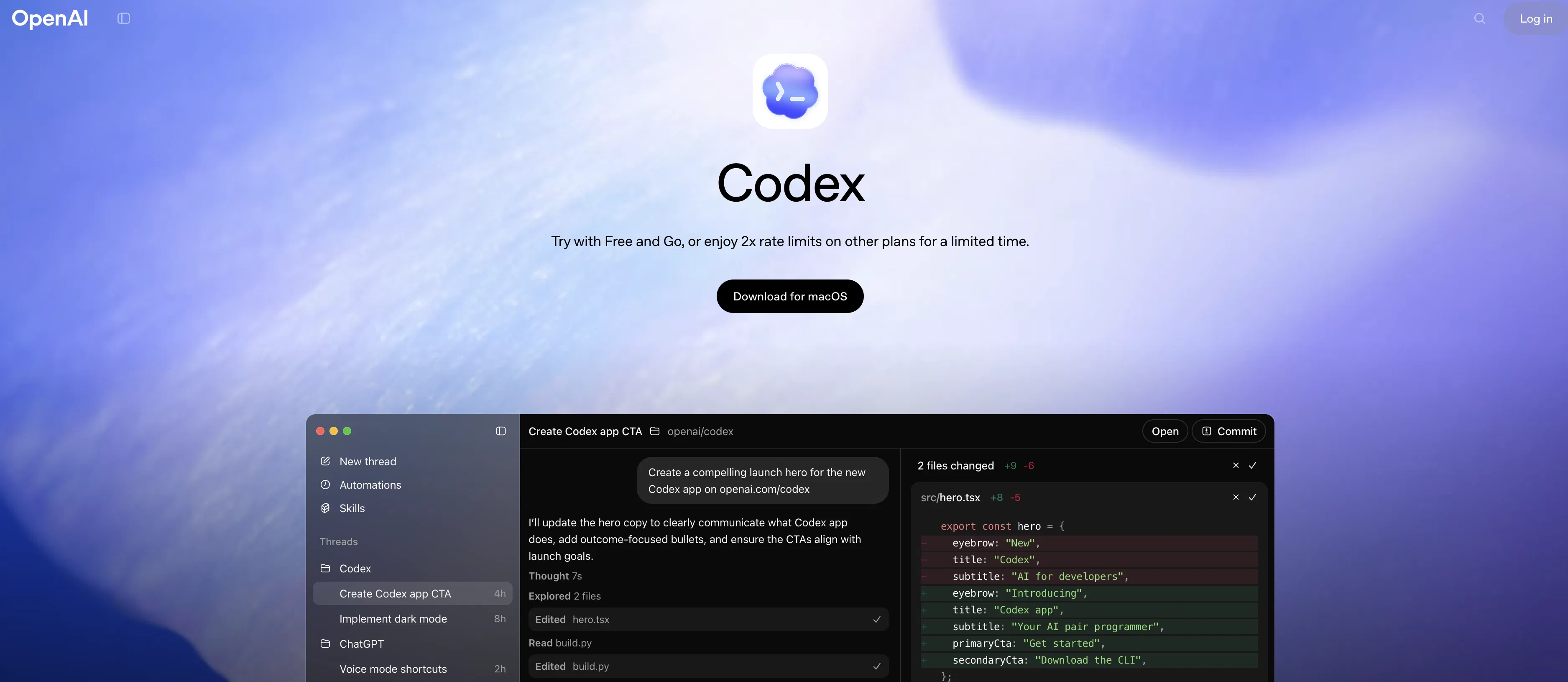
OpenAI Codex is a specialized artificial intelligence model for programming, created by OpenAI. Its primary value lies in its ability to understand instructions formulated in plain English and instantly generate functional code snippets in dozens of programming languages based on them. This allows developers to significantly speed up routine tasks and focus on solving more complex architectural problems.
Key capabilities: automatic code and function completion based on the start of a line or a comment; converting detailed text descriptions into ready-made code blocks; explaining existing code in natural language; refactoring and optimizing written code; translating code from one programming language to another; as well as creating tests and documentation based on logic descriptions.
Unlike general-purpose language models, Codex was specifically fine-tuned on a vast corpus of public code, making it exceptionally accurate in a programming context. Technically, it is a descendant of the GPT-3 model. The most well-known integration of Codex is the GitHub Copilot platform, which embeds its capabilities directly into popular development environments such as Visual Studio Code, JetBrains IDEs, and Neovim. The model is also available via the OpenAI API, allowing integration into custom tools and workflows.
Ideal for professional developers, research engineers, and students learning programming. The tool is indispensable for rapid prototyping when you need to test an idea without spending time writing boilerplate code. It helps experienced specialists automate routine tasks, learn new languages or frameworks, and helps beginners better understand syntax and find working examples. Codex is also useful for educational purposes and for teams aiming to standardize code and speed up the code review process.