
Quench.ai
Transforms company knowledge into interactive chats and role plays to improve team performance.
Are you the owner?
Claim this tool to publish updates, news and respond to users.
Sign in to claim ownership
Sign InDescription
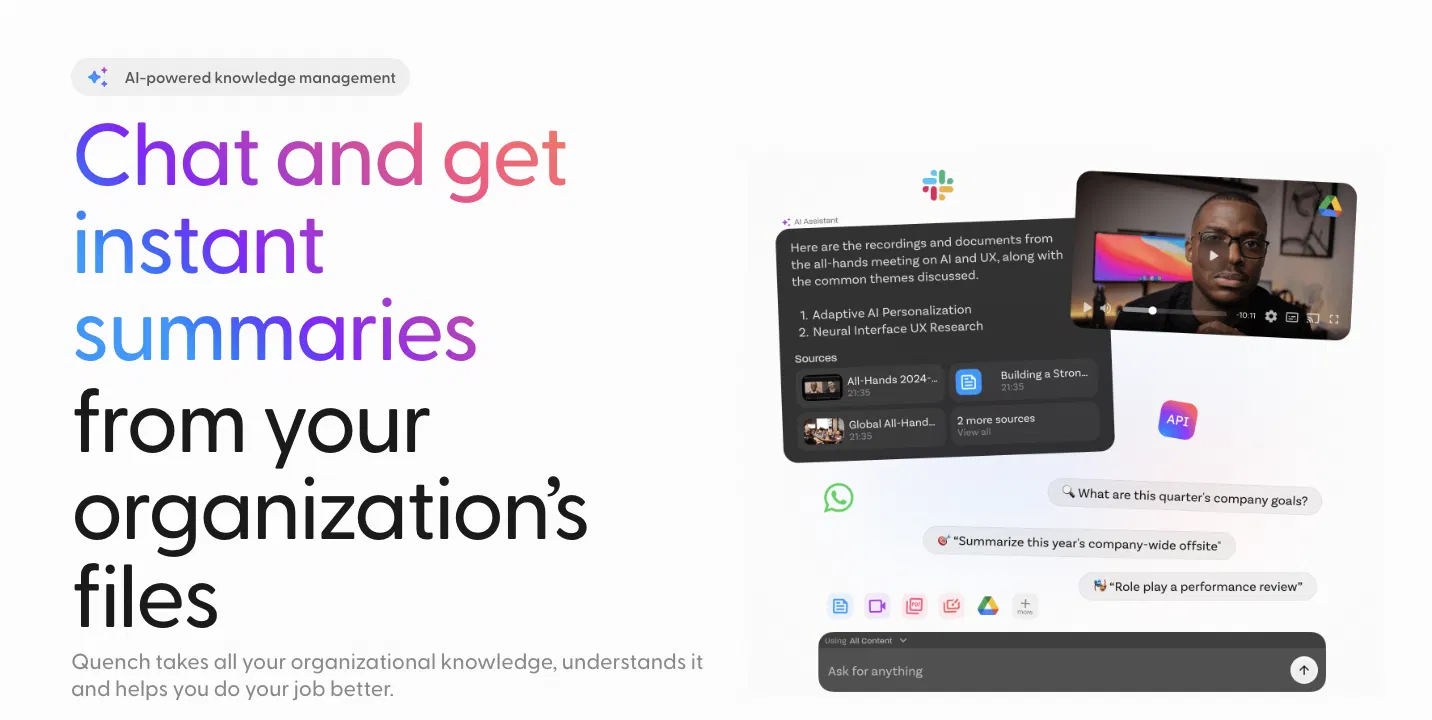
Quench.ai is an AI-powered knowledge management platform designed to help teams overwhelmed by scattered information. It centralizes a company's internal documentation, processes, and expertise into a single, accessible system. The core value proposition is transforming static knowledge bases into dynamic, conversational interfaces that actively assist employees in their daily tasks, thereby reducing time spent searching for information and increasing operational consistency.
Key features: The platform ingests documents, wikis, and other data sources to create a searchable knowledge graph. It enables users to ask questions in natural language and receive precise, context-aware answers pulled from the verified company corpus. A standout capability is the creation of interactive role-play scenarios where employees can practice conversations, such as sales pitches or customer support interactions, guided by company guidelines. It also offers personalized learning paths, tracks knowledge gaps across the organization, and provides analytics on information usage and team competency.
What makes Quench.ai unique is its focus on active learning and application rather than passive retrieval. Technically, it leverages large language models (LLMs) fine-tuned for enterprise contexts to ensure answers are accurate and sourced. It operates as a web application with potential integrations into common workplace tools like Slack, Microsoft Teams, and Google Workspace, allowing knowledge access directly within existing workflows. The system emphasizes security and data sovereignty, keeping all company information private and within its control.
Ideal for mid-to-large-sized companies, especially in sectors like consulting, technology, and customer service, where consistent application of complex procedures is critical. Specific use cases include onboarding new hires by allowing them to 'chat' with company policies, enabling sales teams to rehearse negotiations using real product data, and helping support agents find instant answers to technical issues without leaving their communication platform. It is also valuable for organizations undergoing rapid growth or dealing with high employee turnover, as it effectively captures and disseminates institutional knowledge.