
RenderAI
Transforms hand-drawn sketches into photorealistic images using artificial intelligence.
Are you the owner?
Claim this tool to publish updates, news and respond to users.
Sign in to claim ownership
Sign InDescription
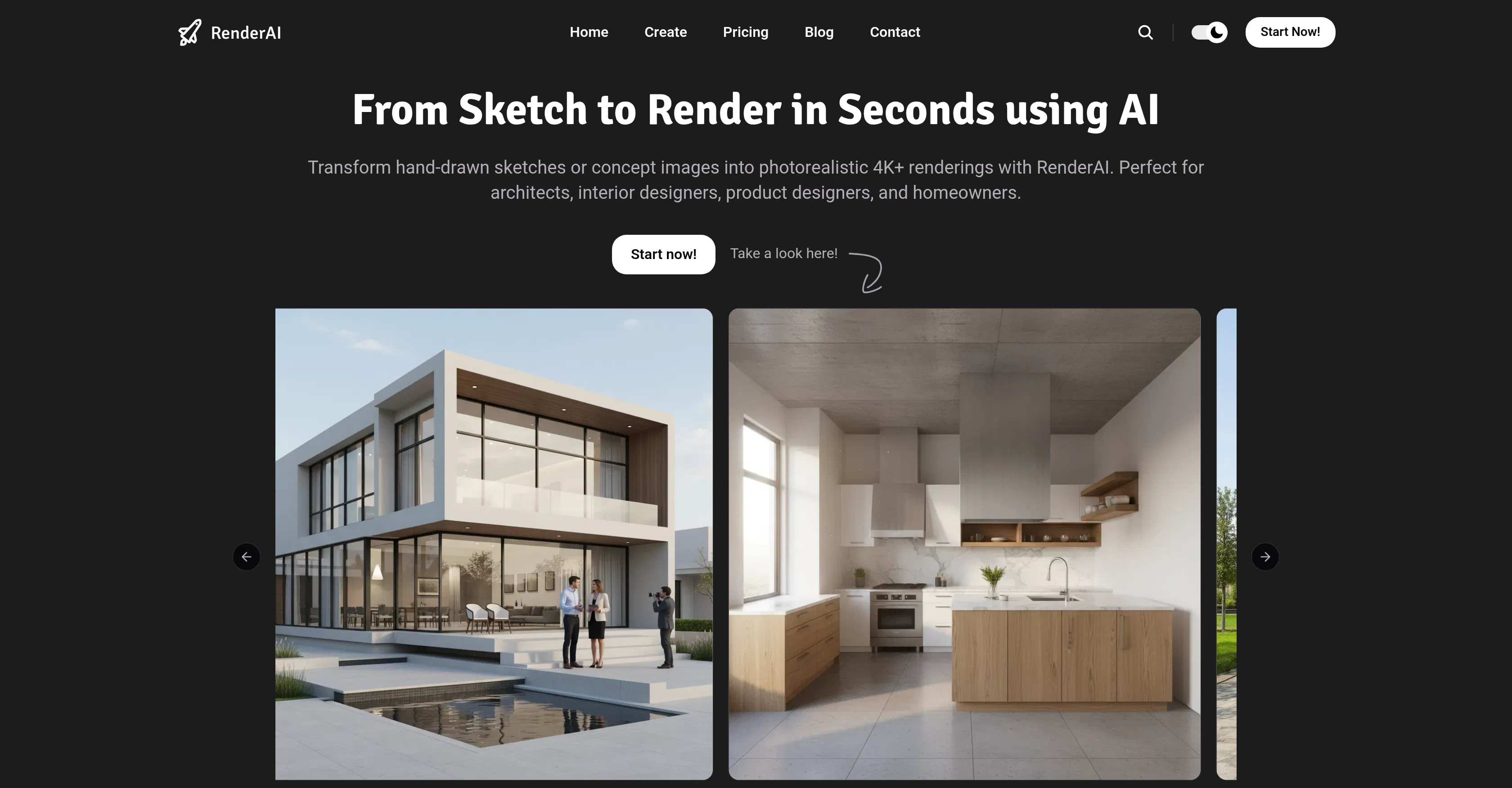
RenderAI is an online application that leverages advanced artificial intelligence to transform simple hand-drawn sketches into high-quality, photorealistic renderings. Developed to bridge the gap between initial concept and final visualization, its core value lies in dramatically accelerating the creative and design process, allowing ideas to be visualized in minutes rather than days. It serves a wide range of professional users, from architects and interior designers to product developers and digital artists, democratizing access to high-end rendering technology.
Key features include the ability to upload a sketch and receive multiple photorealistic variations, adjust styles and lighting conditions post-generation, and iterate rapidly on a single concept. The AI interprets rough lines and shapes, intelligently filling in realistic textures, materials, and environmental context. Users can specify desired moods or material types, such as 'modern concrete' or 'cozy wooden cabin,' guiding the AI towards a more targeted output. The platform supports batch processing for efficiency and offers a straightforward interface that requires no prior 3D modeling or complex software expertise.
What sets RenderAI apart is its specific focus on the sketch-to-render pipeline, optimizing its neural networks for interpreting the intent behind imperfect drawings rather than just enhancing existing photos. It operates entirely in the cloud via a web browser, requiring no software downloads or powerful local hardware. While it may not offer deep integrations with CAD software yet, its standalone nature and API potential make it a flexible tool. The underlying technology likely combines diffusion models with specialized training on architectural and design datasets to achieve its convincing material and spatial accuracy.
Ideal for architects needing quick client presentations of facade ideas, interior designers experimenting with different furniture layouts and finishes, and industrial designers visualizing product concepts before prototyping. It is equally valuable for real estate agents creating compelling visuals of planned properties, educators teaching design principles, and marketing teams generating assets for campaigns based on early storyboards. Essentially, any professional or creator who needs to convert a rough idea into a convincing visual reality without the overhead of traditional rendering can benefit from this tool.