ScienceOS
Assists researchers in exploring scientific literature, generating answers, tables, diagrams, and citation networks.
Are you the owner?
Claim this tool to publish updates, news and respond to users.
Sign in to claim ownership
Sign InDescription
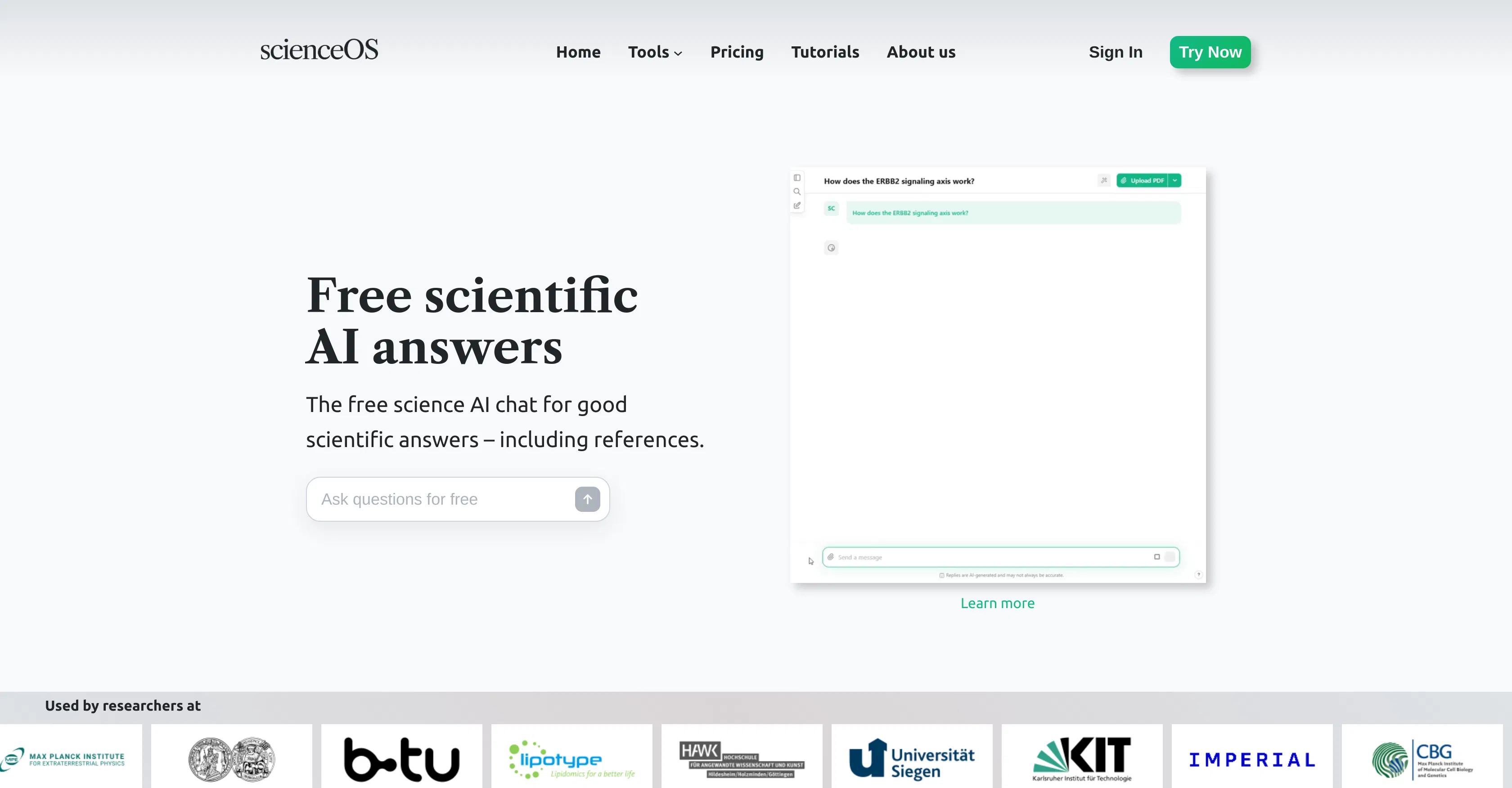
ScienceOS is an AI-powered research assistant developed by the scienceOS team, designed to streamline and enhance the literature exploration process for academics and scientists. Its core value lies in providing immediate, context-aware access to a vast database of research papers, effectively acting as an intelligent intermediary between a researcher and the sprawling body of scientific knowledge. By understanding complex queries, it delivers precise information, saving countless hours traditionally spent on manual searches and preliminary paper reviews.
Key features include a conversational chat interface for posing detailed research questions and receiving synthesized answers backed by source citations. The tool can automatically create structured tables to compare methodologies or results across different studies and generate visual diagrams to illustrate concepts or relationships. A particularly powerful feature is its ability to draw interactive citation networks, visually mapping the connections between seminal papers and subsequent research to reveal the evolution of a scientific field. It also supports document upload for analyzing specific papers within its contextual framework.
What makes ScienceOS unique is its dedicated focus on the academic research workflow, built upon an extensive and continuously updated database of peer-reviewed literature. Unlike general-purpose chatbots, it is fine-tuned to comprehend scientific terminology and provide traceable, credible answers. The platform is primarily web-based, accessible through a browser, ensuring ease of use without complex installations. Its technical foundation allows it to process and connect information from millions of papers, offering insights that would be difficult to glean manually.
Ideal for graduate students conducting literature reviews for their theses, postdoctoral researchers staying current in fast-moving fields, and principal investigators scoping out new project areas or identifying key papers and collaborators. Specific use cases include quickly summarizing the consensus on a debated topic, identifying the most influential papers on a given subject through citation network analysis, and preparing comparative data tables for inclusion in review articles or grant proposals. It serves as a force multiplier for anyone engaged in deep scientific inquiry.