Shuttle
Enables rapid creation and deployment of cloud applications by automating infrastructure.
Are you the owner?
Claim this tool to publish updates, news and respond to users.
Sign in to claim ownership
Sign InDescription
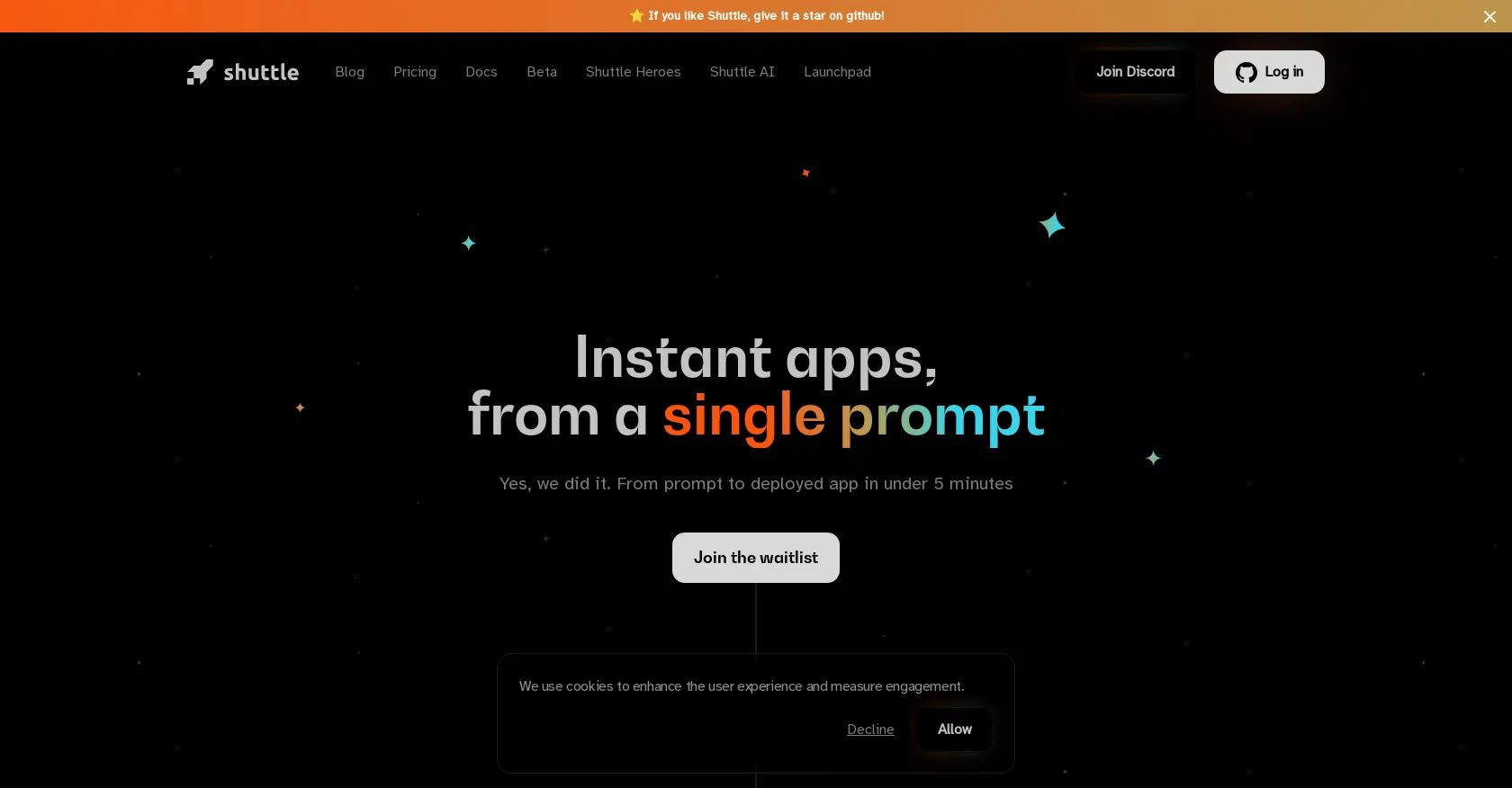
Shuttle is an AI platform for rapid development and deployment of cloud applications, created by Shuttle. Its primary value lies in automating complex infrastructure, allowing developers to focus solely on writing code rather than managing servers, containers, or network configurations. The platform uses artificial intelligence to optimize deployment processes and provides a ready-to-use environment for launching projects.
Key features: automatic setup and scaling of cloud infrastructure for each project, instant application deployment from code without manual configurations, built-in database and caching, dependency and runtime environment management, monitoring and logging tools, and integration with popular version control systems such as GitHub. The platform abstracts DevOps complexities, offering developers a simple command-line interface and web dashboard.
A key differentiator of Shuttle is its developer-centric architecture, where infrastructure is described declaratively directly in the application code using annotations. Technically, the platform supports multiple programming languages, including Rust, Python, and JavaScript, and deploys applications in isolated containers. It integrates with cloud providers to ensure high availability and security. Shuttle operates on a Platform-as-a-Service (PaaS) model but with deep AI-driven automation to optimize resources and performance.
Ideal for individual developers, startups, and small teams who want to quickly launch prototypes, MVPs, or microservices without spending time on DevOps. Use cases include creating backend services, APIs, web applications, and workflow automation. The tool is particularly useful for educational projects and hackathons where deployment speed is crucial, as well as for professionals aiming to shorten the development cycle and focus on business logic.