Tray.io
Automates business processes and connects diverse systems using AI.
Are you the owner?
Claim this tool to publish updates, news and respond to users.
Sign in to claim ownership
Sign InDescription
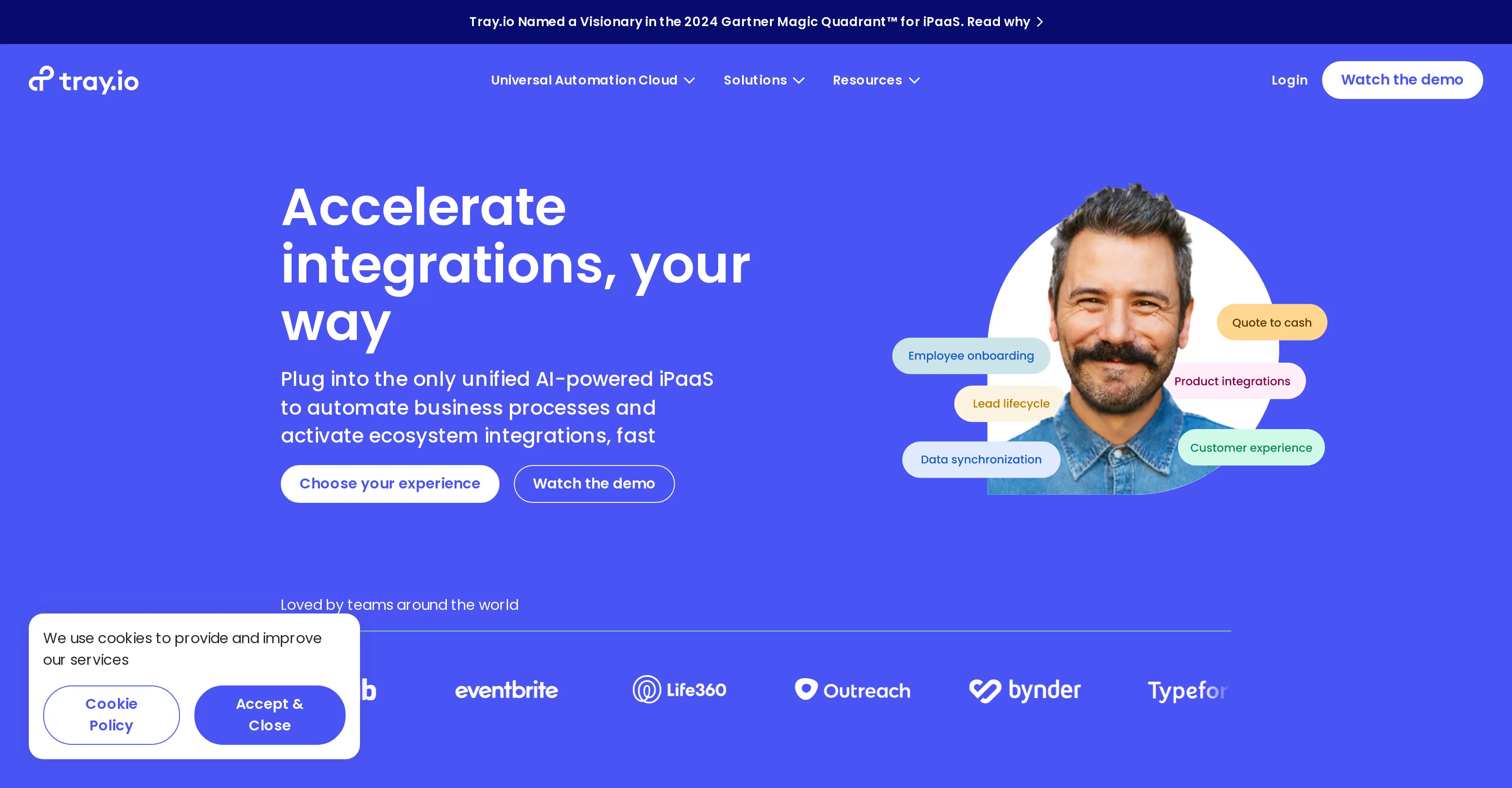
Tray.io is a unified integration platform (iPaaS) created by the company of the same name, which uses artificial intelligence to automate workflows and simplify connections between heterogeneous systems. Its core value lies in providing a flexible and powerful tool that enables both technical and business users to build complex action chains (workflows) without requiring deep programming knowledge, thereby accelerating digital transformation and enhancing operational efficiency.
Key features: the platform offers a visual workflow designer with a drag-and-drop interface for creating complex integrations. It includes an AI assistant that helps generate and describe automation logic. The system provides pre-built connectors for thousands of popular cloud and on-premise applications, ranging from CRM and marketing tools to databases. Advanced data processing functions are also available, including transformation, logic branching, and error handling, enabling the construction of reliable and fault-tolerant processes.
A distinctive feature of Tray.io is its versatility and scalability, suitable for both simple automations and enterprise integrations. Technically, it is a cloud platform that also supports hybrid scenarios with on-premise systems via special agents. It provides detailed logging, real-time monitoring, and debugging tools, which are critically important for supporting complex processes. The platform actively develops its ecosystem, allowing integration of both ready-made SaaS solutions and custom APIs, making it a central hub for managing a company's entire IT infrastructure.
Ideal for development teams, integration engineers, as well as business analysts and department heads in medium and large companies seeking to automate routine tasks. Typical use cases include sales and marketing process automation (e.g., lead synchronization between CRM and marketing platforms), customer support automation, data orchestration between various storage systems, and creating complex business processes spanning multiple departments. The tool is particularly valuable in situations requiring flexibility and rapid integration deployment without constant developer involvement.