Flowtest
Automates and enhances Quality Assurance testing for websites to identify issues before users encounter them.
Are you the owner?
Claim this tool to publish updates, news and respond to users.
Sign in to claim ownership
Sign InDescription
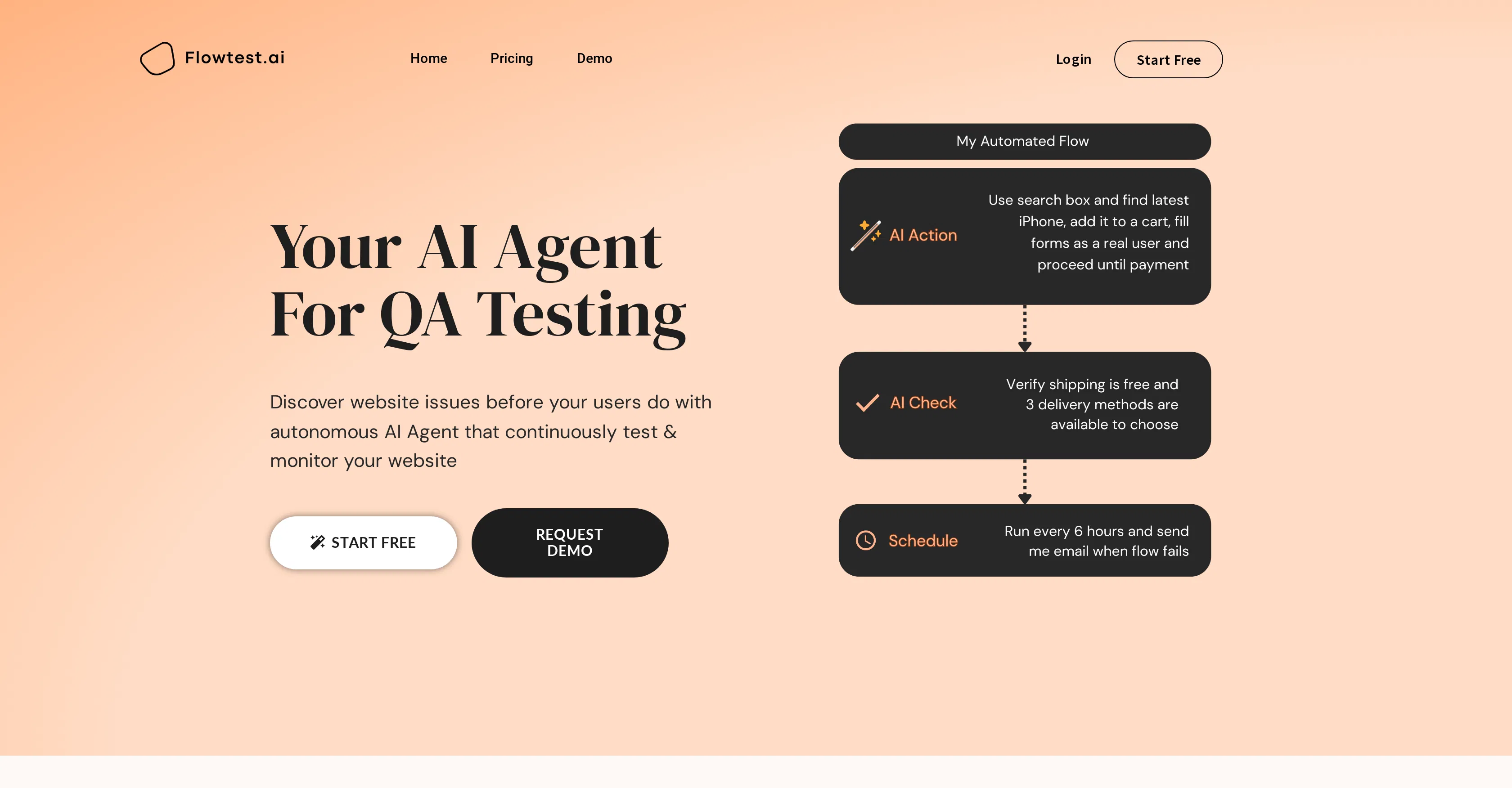
Flowtest.ai is an AI-powered tool created to automate and elevate the entire Quality Assurance (QA) testing process for websites. Its core mission is to proactively identify and report functional, visual, and performance issues before they impact real users, thereby safeguarding user experience and brand reputation. By continuously testing and monitoring a website, it significantly reduces the manual effort, time, and inconvenience traditionally associated with comprehensive QA cycles, allowing development and QA teams to focus on higher-value tasks.
Key features: The platform autonomously generates and executes test scripts that mimic real user interactions across different browsers and devices. It provides intelligent visual regression testing to detect unintended UI changes and layout breaks. The system offers detailed, actionable reports with screenshots, logs, and step-by-step error reproduction paths. It supports scheduled and on-demand test runs, integrates with CI/CD pipelines for automated deployment checks, and can monitor critical user journeys and conversion funnels for stability.
What makes Flowtest.ai unique is its use of AI to understand application structure and user flows, enabling it to create adaptive tests that remain robust even after minor UI updates. It operates as a cloud-based SaaS platform, requiring no complex infrastructure setup. Technically, it can handle dynamic web applications built with modern frameworks like React, Angular, and Vue.js. For integration, it offers APIs and native plugins for popular tools like GitHub Actions, Jenkins, and Slack, facilitating seamless incorporation into existing development workflows.
Ideal for web development agencies, SaaS companies, and in-house product teams that need to ensure their digital products are consistently functional and performant. Specific use cases include regression testing after new feature deployments, cross-browser compatibility validation, monitoring the checkout process on e-commerce sites, and maintaining quality for customer-facing portals that receive frequent updates, ultimately preventing revenue loss and support tickets caused by site failures.