PromNest
Organizes, manages, and automates AI prompts for individuals and teams working with models like ChatGPT and Claude.
Are you the owner?
Claim this tool to publish updates, news and respond to users.
Sign in to claim ownership
Sign InDescription
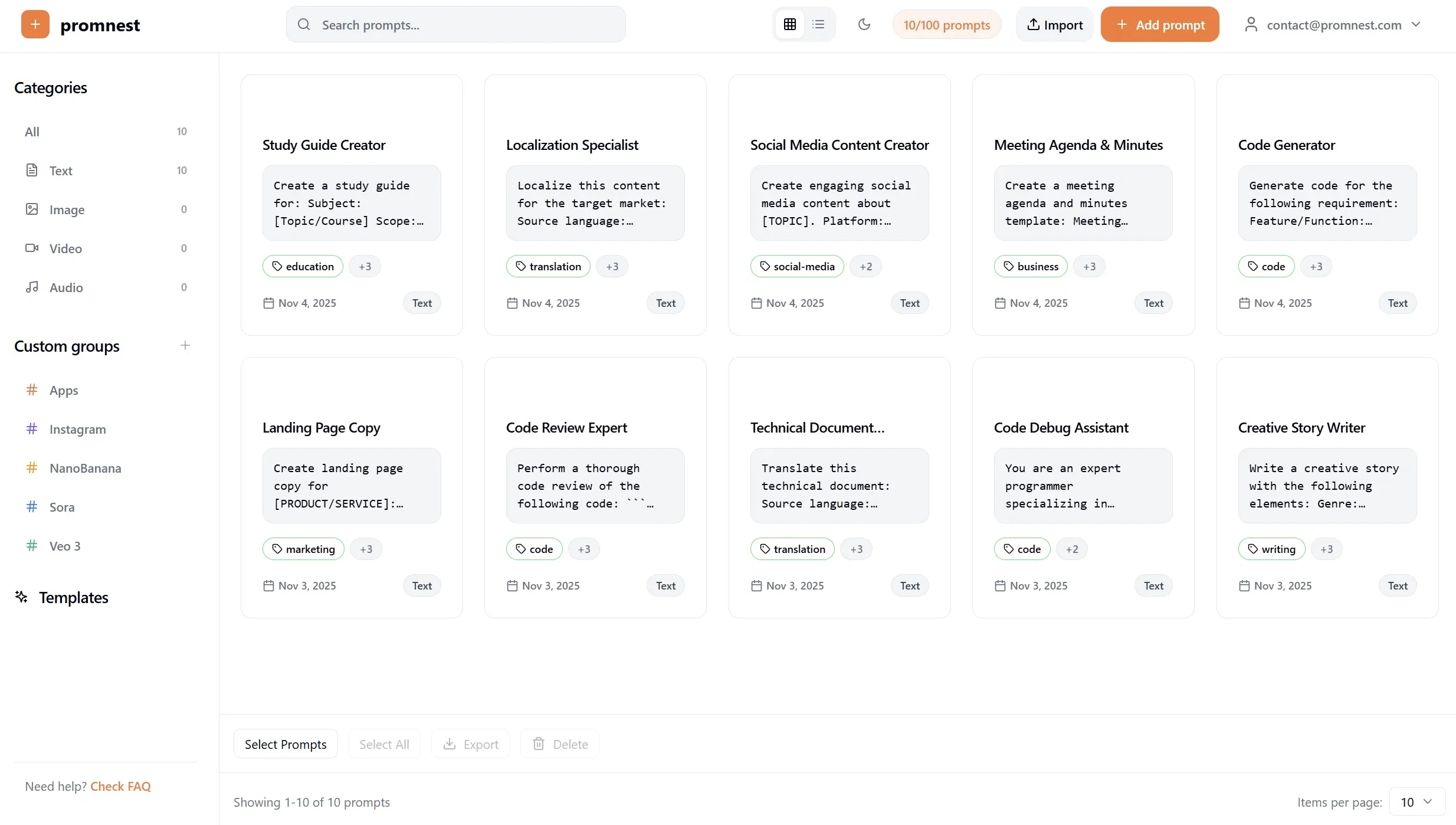
PromNest is a comprehensive platform designed to streamline the workflow of anyone using generative AI models. It provides a centralized hub for organizing, managing, and automating prompts, addressing the common challenge of prompt sprawl and inefficiency. The tool's core value lies in transforming ad-hoc AI interactions into a structured, repeatable, and scalable process, thereby boosting productivity and output consistency for both solo practitioners and collaborative teams.
Key features include a robust prompt library for categorization and versioning, enabling users to build a personal or shared knowledge base of effective instructions. It offers automation capabilities through native integrations and a REST API, allowing prompts to be triggered from other applications or scheduled to run autonomously. The platform supports team collaboration with shared workspaces and permission controls, and includes analytics to track prompt performance and usage patterns over time.
What sets PromNest apart is its focus on being a connective layer within the AI tooling ecosystem, rather than just a local storage solution. Its REST API is a pivotal technical feature, enabling seamless integration with major automation platforms like n8n, Zapier, and Make.com, as well as custom applications. This makes it a powerful backend for building AI-powered workflows. It is a web-based platform, ensuring accessibility from any device, and is designed to be model-agnostic, working seamlessly with popular LLMs including ChatGPT, Claude, Gemini, and others.
Ideal for developers, content teams, researchers, and businesses that rely heavily on generative AI for daily tasks. Specific use cases include marketing teams automating content brief generation, customer support teams managing canned response libraries, data analysts standardizing data cleaning prompts, and developers building AI features into their own products via the API. It is particularly valuable for organizations looking to institutionalize AI best practices and reduce prompt-related friction in collaborative environments.