
Superflex
Generates production-ready React components from Figma designs with one click, eliminating manual coding.
Are you the owner?
Claim this tool to publish updates, news and respond to users.
Sign in to claim ownership
Sign InDescription
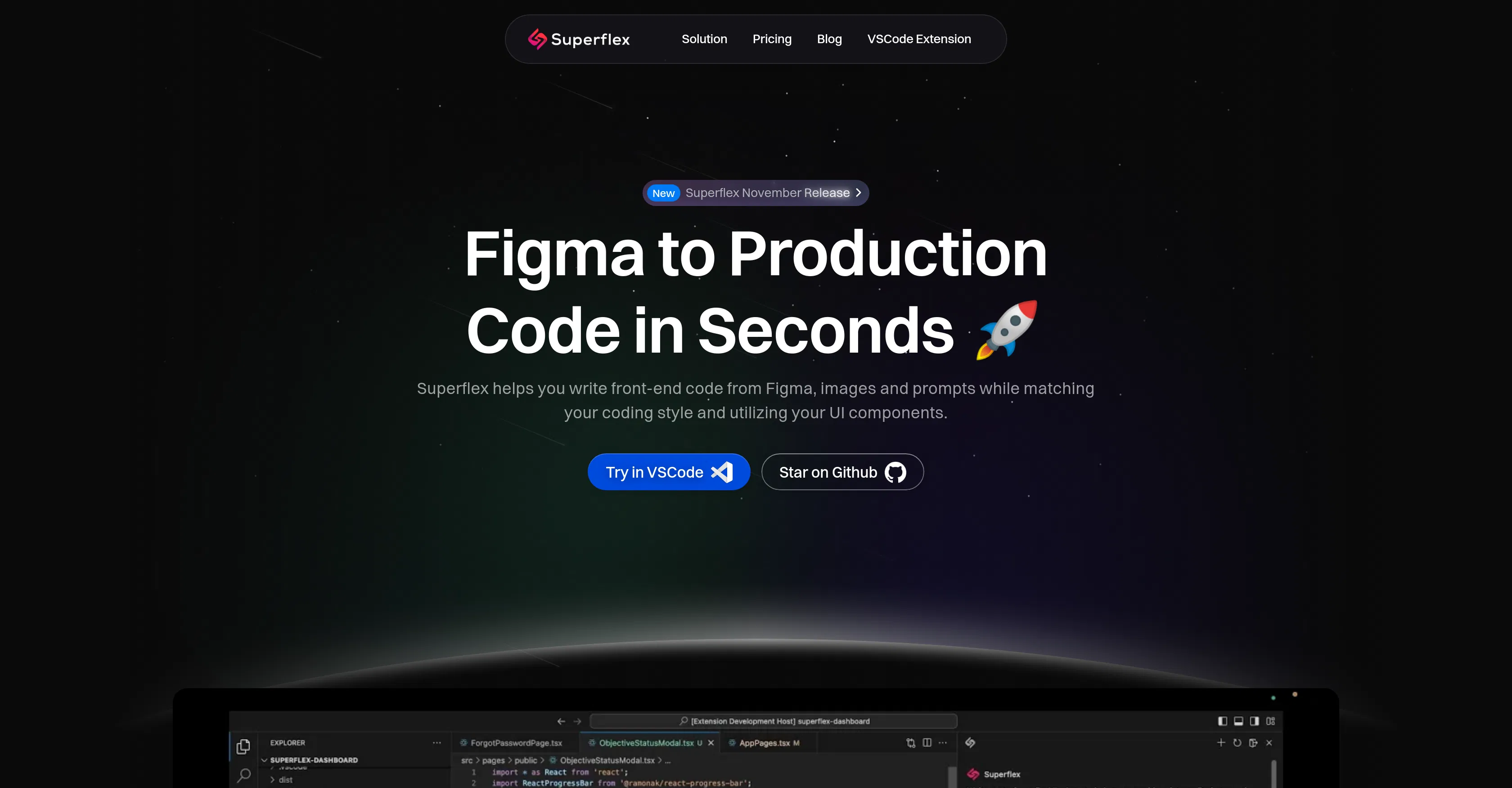
Superflex is an AI-powered developer tool that automatically converts Figma designs into clean, production-ready React code. Created by a team focused on bridging the gap between design and engineering, its core value lies in dramatically accelerating frontend development by automating the tedious process of translating visual designs into functional components. It empowers developers to focus on logic and architecture rather than repetitive styling and markup, thereby streamlining the entire product development lifecycle.
Key features: the tool provides one-click generation of React components (including JSX, CSS, and props) directly from Figma frames, supports responsive design principles by creating adaptive layouts, ensures the code follows best practices and maintains consistency with the original design system, and allows for direct integration into existing projects with minimal configuration. It also includes features for managing design tokens and generating TypeScript definitions to enhance type safety.
What makes Superflex unique is its deep understanding of design-system semantics and its ability to produce human-readable, maintainable code rather than just static markup. Technically, it parses Figma's API to interpret layers, constraints, and auto-layout properties, transforming them into logical React structures. It is a web-based platform that integrates seamlessly into a developer's workflow via plugins or direct API access, and it emphasizes customization, allowing teams to define their own code-generation rules and templates to match internal standards.
Ideal for frontend developers, engineering teams in startups and digital agencies, and product managers overseeing UI implementation. Specific use cases include rapidly prototyping new features from design mockups, maintaining consistency between design and code in large-scale applications, onboarding new developers to a project's UI framework, and reducing the back-and-forth between design and development teams, ultimately shipping features faster with fewer visual regressions.