Jovu
Generates production-ready code from concept using AI to accelerate development workflows.
Are you the owner?
Claim this tool to publish updates, news and respond to users.
Sign in to claim ownership
Sign InDescription
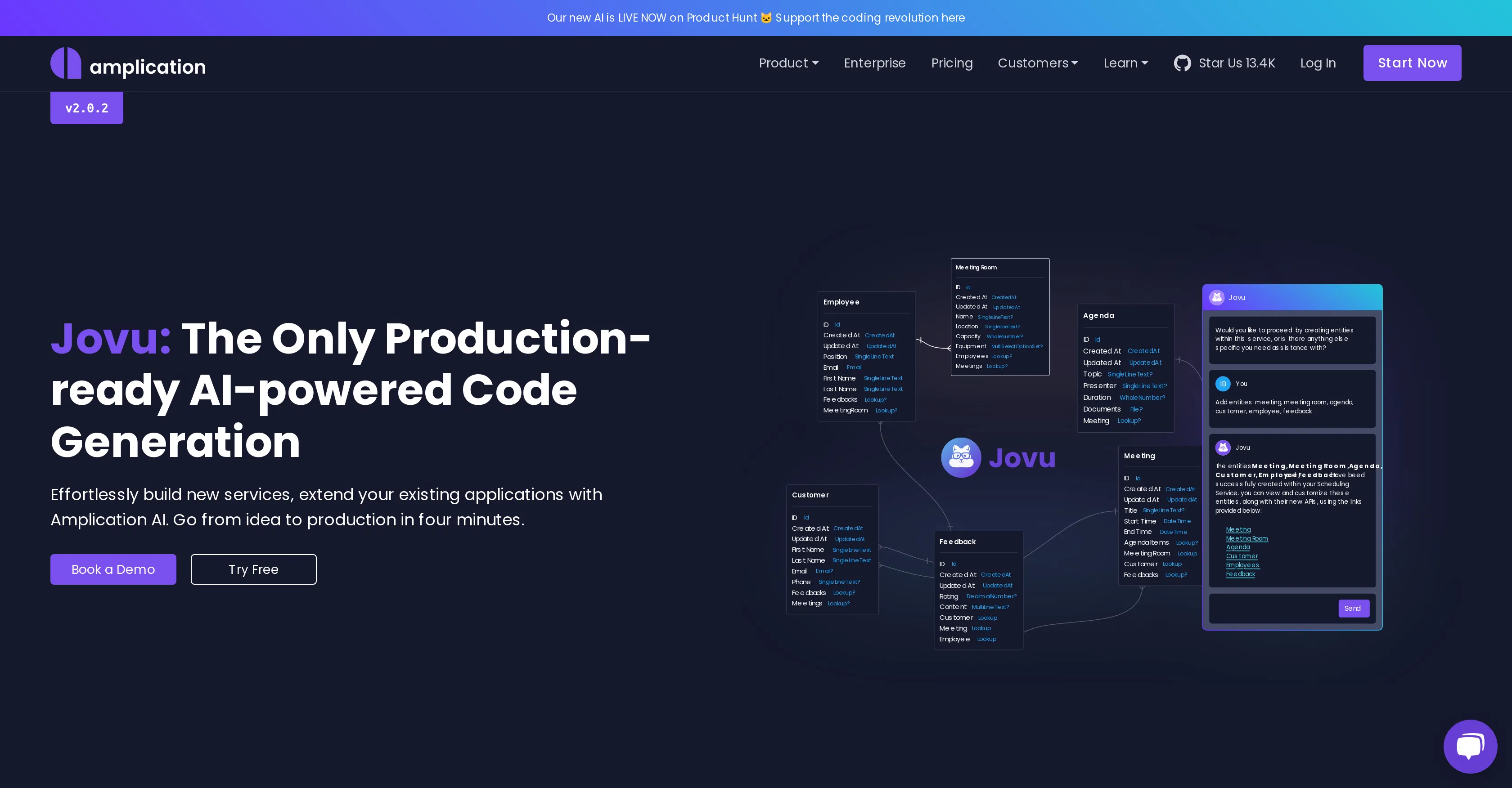
Jovu, developed by Amplication, is an AI-powered code generation tool designed to dramatically accelerate the software development lifecycle. It transforms high-level concepts and specifications into fully functional, production-ready code, enabling developers and teams to move from idea to deployment with unprecedented speed and reduced manual effort. The core value proposition lies in its ability to automate the foundational and often repetitive aspects of coding, allowing human developers to focus on complex logic, architecture, and innovation.
Key features: The tool can generate complete backend services, including data models, APIs with REST or GraphQL endpoints, and database schemas based on natural language descriptions. It automatically produces authentication and authorization layers, role-based access control, and essential boilerplate code. Jovu integrates real-time logging and monitoring hooks into the generated codebase and supports the creation of admin UIs for data management. It also facilitates the generation of deployment configurations for containerized environments.
What makes Jovu unique is its explicit focus on generating "production-ready" code, meaning the output includes error handling, security best practices, and is structured according to modern architectural patterns. It is not just a code snippet generator but a system builder. Technically, it leverages large language models fine-tuned for code synthesis. The platform is cloud-based and integrates directly into development environments, offering plugins for popular IDEs and seamless connectivity with version control systems like GitHub for continuous integration and deployment pipelines.
Ideal for software development teams, startup founders building MVPs, and enterprise developers under tight deadlines who need to prototype or build backend services rapidly. Specific use cases include quickly spinning up a secure admin panel for a new application, generating a complete CRUD API for a product catalog, or establishing a microservice foundation for a larger distributed system without writing thousands of lines of boilerplate code manually.