CodeViz
Visualizes codebases with detailed architecture maps to accelerate feature delivery and improve comprehension.
Are you the owner?
Claim this tool to publish updates, news and respond to users.
Sign in to claim ownership
Sign InDescription
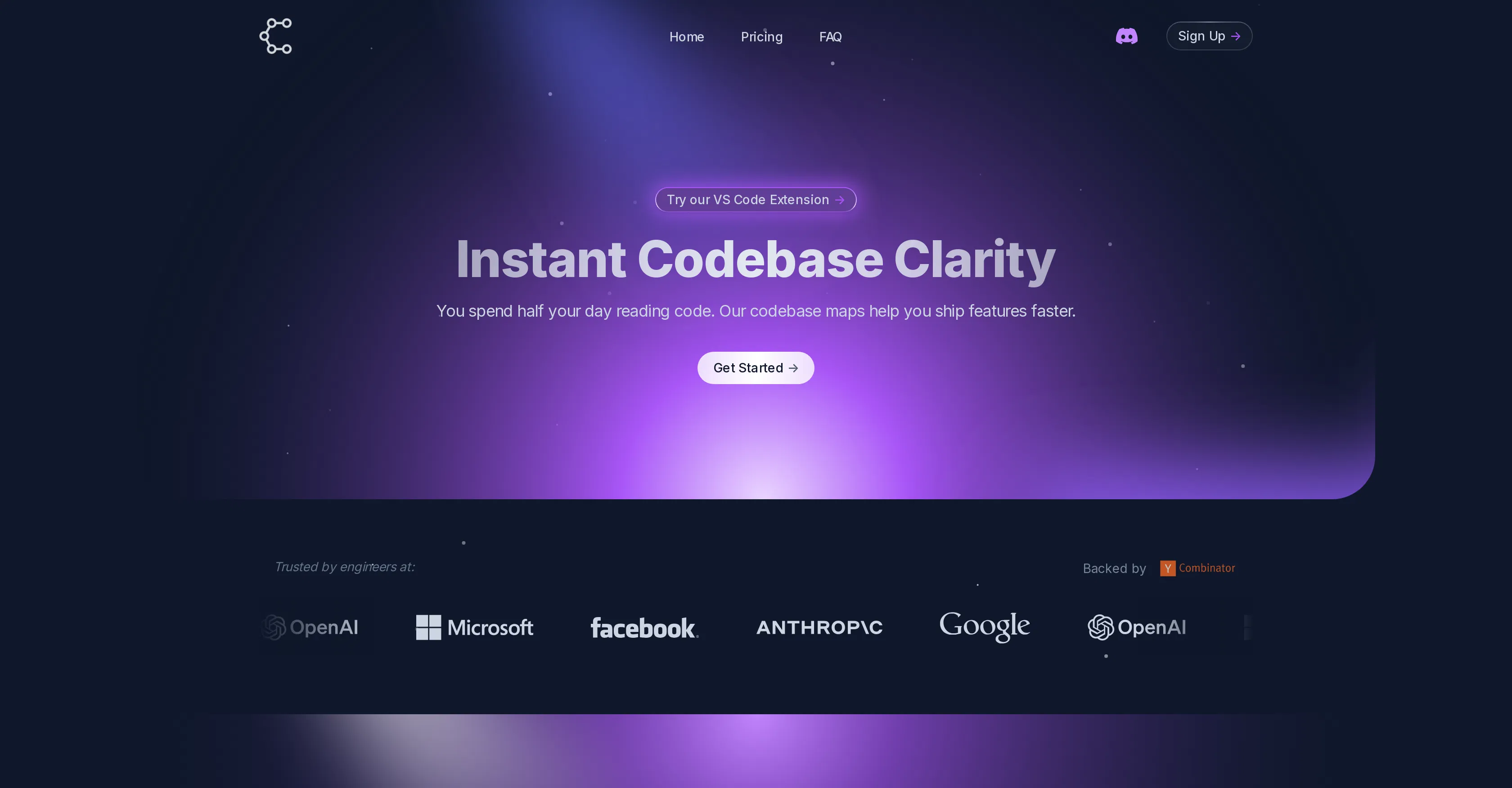
CodeViz is an advanced code visualization platform engineered to transform how developers understand and navigate complex codebases. Its core value lies in accelerating the software development lifecycle by providing clear, interactive visual representations of a project's structure, which helps teams identify dependencies, understand legacy code, and onboard new members significantly faster than traditional methods. By mapping out the entire architecture, it reduces the cognitive load on developers, allowing them to focus on building features rather than deciphering code.
Key features include the generation of multi-level architecture maps that break down a system from high-level components down to individual files and functions. The platform offers question-based visualization, allowing developers to ask natural language queries about the codebase and receive visual answers. It provides on-demand file analysis to drill into specific modules, real-time collaboration tools for team discussions directly on the visual maps, and automated documentation generation that stays synchronized with the code changes, ensuring diagrams are never outdated.
What sets CodeViz apart is its intelligent parsing engine that supports a wide range of programming languages and frameworks, creating accurate and actionable diagrams without requiring manual annotation from developers. It operates as a web-based SaaS platform with optional integrations into popular development environments and CI/CD pipelines, enabling visualization as part of the standard workflow. The underlying technology uses static analysis to build its models, ensuring the visualizations are precise and reflect the actual code state, not just the intended design.
Ideal for software development teams, engineering managers, and individual developers working on medium to large-scale projects, especially those dealing with microservices architectures, legacy system modernization, or complex monolithic applications. Specific use cases include conducting architecture reviews, planning refactoring efforts, streamlining the onboarding process for new hires, and facilitating knowledge sharing across distributed teams to reduce bus factor and improve overall code quality and maintainability.