
The Profanity API
Detects and filters profanity in text using AI-powered contextual analysis for content moderation.
Are you the owner?
Claim this tool to publish updates, news and respond to users.
Sign in to claim ownership
Sign InDescription
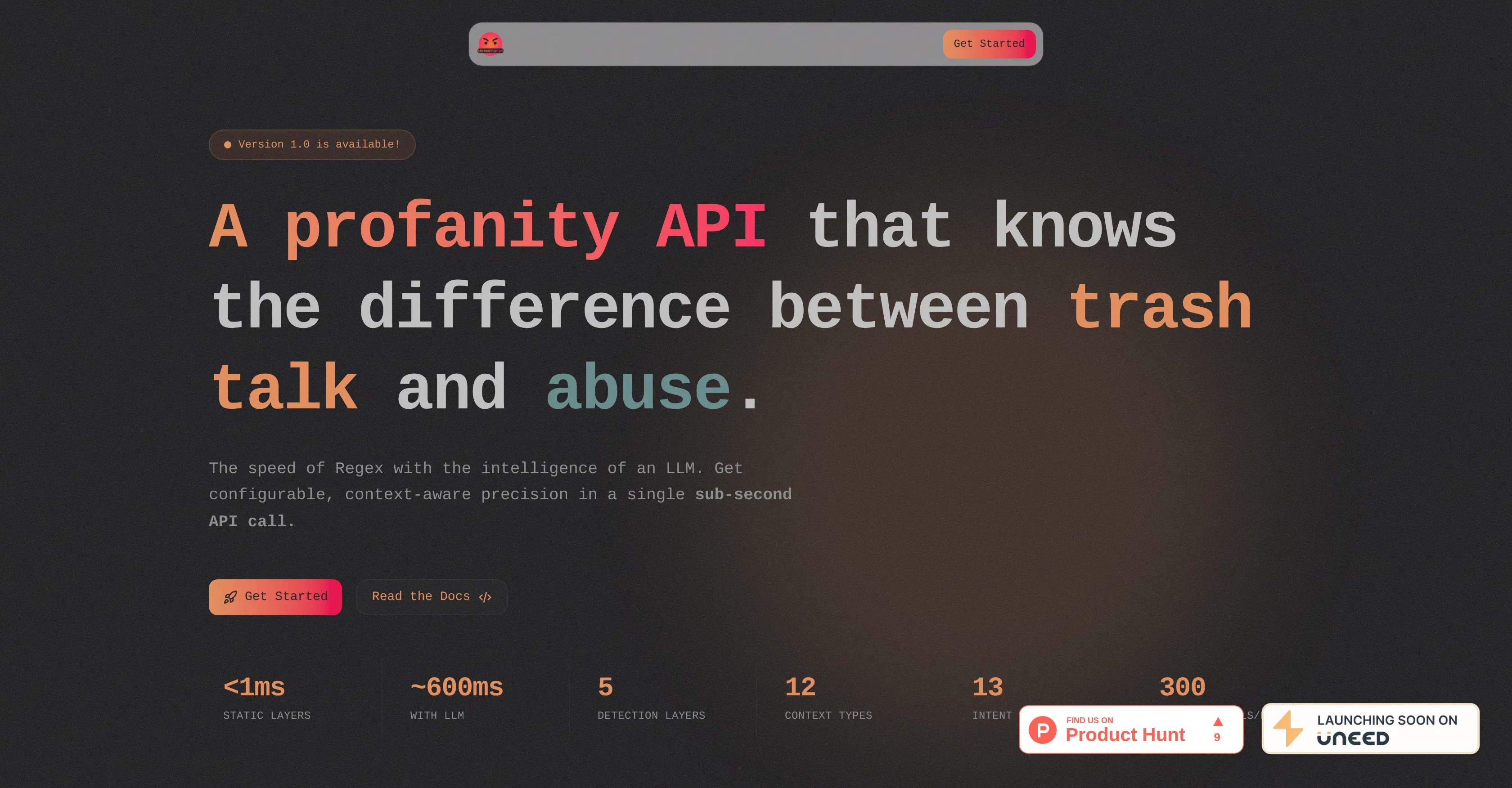
The Profanity API is a specialized content moderation tool developed for software engineers and developers, designed to intelligently identify and filter inappropriate language within user-generated text. Its core value lies in moving beyond simplistic keyword blocking to understand the nuanced context in which words are used, thereby reducing false positives and improving the accuracy of automated moderation systems. This allows platforms to maintain safer, more respectful online environments without relying solely on manual review, which can be slow and inconsistent.
Key features include the ability to detect profanity across multiple languages, recognize masked or obfuscated swear words (like using symbols or misspellings), and provide a confidence score for each detection. The API can also identify different severity levels of profanity, from mild expletives to highly offensive slurs, and offers the option to censor or simply flag offending content. Furthermore, it can be configured to understand context-specific allowances, such as distinguishing between aggressive harassment and the quoting of offensive material in an educational setting.
What sets this tool apart is its foundation in machine learning models trained on diverse datasets, enabling it to grasp slang, cultural nuances, and evolving internet language. It operates as a straightforward REST API, making it easy to integrate into virtually any application stack, backend service, or moderation pipeline with minimal development overhead. The service is cloud-based, ensuring scalability and consistent performance without the need for local model deployment or maintenance, and it includes detailed documentation and client libraries for popular programming languages to speed up implementation.
Ideal for social media platforms, online gaming communities, chat applications, and educational forums that handle large volumes of user-generated text. Specific use cases include automatically moderating comment sections, screening in-game chat for toxicity, filtering user-submitted reviews or forum posts, and ensuring compliance with community guidelines in real-time. It is equally valuable for developers building SaaS products that require built-in content safety features, helping them protect their brand reputation and user experience from the outset.